What Benefits Can Solar Carports Bring To Investors?
The solar energy is more and more widely used in people’s daily life, especially the solar carport. It brings solar energy, meanwhile is acting a carport function. So while we using the solar carport, what benefits can solar carports bring to investors?
The Role of Solar Carports in Charging Stations
First, the role of photovoltaic power generation systems in charging stations lies in their direct utilization of renewable energy. Solar panels installed on the roof or carport of the charging station convert solar energy into electricity for use in the charging station. This local resource-based approach reduces energy losses during transmission and improves energy efficiency.
Second, the combination of solar power generation and energy storage systems plays a crucial role in charging stations. During periods of abundant sunlight, the energy storage system stores excess photovoltaic power generation, while at night or during periods of low sunlight, the energy storage system releases this energy to ensure continuous operation of the charging station.
This peak-shaving and valley-filling effect not only balances power supply and demand on the grid, but also reduces load pressure and improves grid stability. Furthermore, the presence of energy storage systems allows charging stations to store electricity during low electricity prices and discharge it during peak hours, thereby reducing operating costs.
The introduction of solar power also enhances the environmental friendliness of charging stations. By utilizing solar energy, charging stations can reduce their reliance on traditional fossil fuels, reduce greenhouse gas emissions, and promote sustainable development. PV charging stations can also serve as educational and demonstration platforms, raising public awareness and acceptance of renewable energy and clean energy vehicles.
Finally, advances in photovoltaic technology and reductions in costs have expanded the potential for their application in charging stations. With the increasing efficiency and decreasing costs of PV modules, the economic viability of PV charging stations has significantly improved. Furthermore, the development of smart grid and microgrid technologies has provided technical support for maximizing the utilization and optimizing the scheduling of PV power generation.
The Return on Investment of PV Carports
PV carports have a low cost per square meter, and compared to conventional membrane structure carports, the additional cost per square meter is minimal. The added cost can be recovered through the electricity generation revenue.
How do we calculate the return on investment from charging stations? Beyond the basic revenue generated by the per-kilowatt-hour charging service fee, charging stations in some provinces and regions can also apply for government subsidies and generate revenue through advertising space on the walls or on the charging stations.
Notably, France recently enacted new regulations mandating the installation of solar panels in parking lots larger than 1,500 square meters. The new regulations clarify that parking lots over 10,000 square meters must install solar carports by July 1, 2026, while parking lots between 1,500 and 10,000 square meters must have them installed by July 2, 2028. At least 50% of the parking area (including the driveway) must be covered by a sunshade or green canopy. Violations will be subject to a fine of €40,000 (US$42,160) per year until the violation is resolved.
The promulgation of these new regulations has not only sparked global attention to photovoltaic carports, but has also brought them to the forefront of urban development.
How to Choose a PV Carport Structure?
- N-Type Structure
The N-type structure is a flat, single-slope structure, with all photovoltaic panels tilted in one direction.
Advantages: This structure is simple to construct and low-cost, suitable for small carports or single-row parking lots. It also provides excellent drainage, reducing water accumulation.
Disadvantages: It occupies a large area, resulting in low land utilization. The fixed orientation of the photovoltaic panels prevents full utilization of sunlight.
Applicable Scenario: Rural or sparsely populated parking lots.

- H-Type Structure
The H-type structure is a double-slope symmetrical structure, similar to a traditional house roof.
Advantages: Strong wind resistance and structural stability. High utilization rate and bifacial power generation. Aesthetically pleasing and suitable for urban parking lots.
Disadvantages: Slightly higher cost and complex installation.
Applicable Scenario: Mid- to high-end urban parking lots or large-scale commercial parking lots.
- V-Type Structure
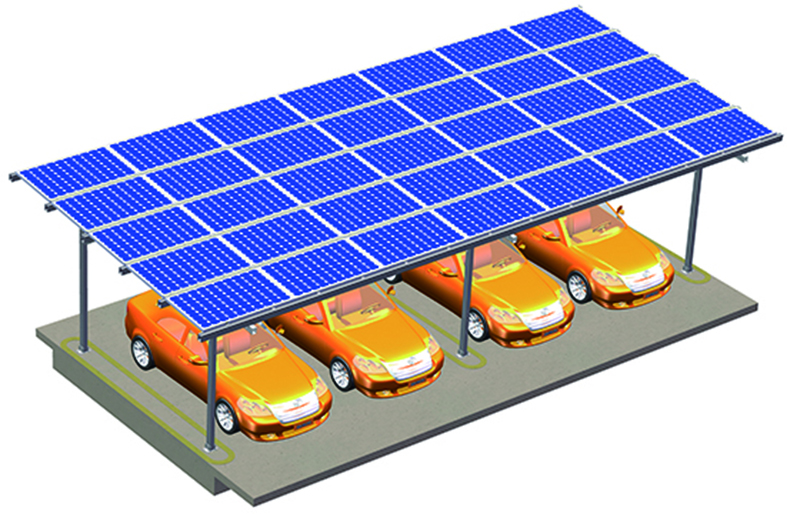
The V-type structure is similar to a “V” shape, with the top of the carport tilted to the sides.
Advantages: It can direct rainwater or snow to the sides for drainage. It has good earthquake and wind resistance.
Disadvantages: Requires high material requirements and high installation cost.
Applicable Scenario: Parking lots in extreme climates, such as rainy or snowy areas.
- Y-Type Structure
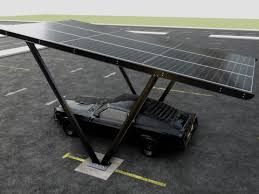
The Y-type structure has a “Y”-shaped roof, similar to an umbrella.
Advantages: Highly aesthetically pleasing and can become a landmark. Suitable for single-space design and high flexibility.
Disadvantages: High cost, not suitable for large parking lots.
Applicable scenarios: High-end commercial complex parking lots.

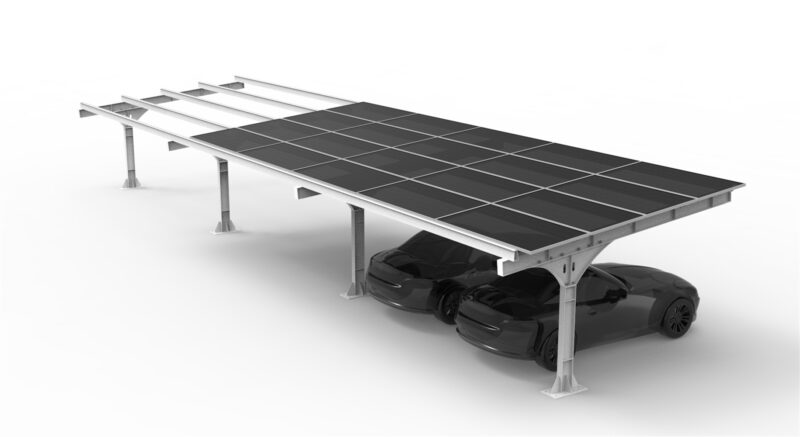
- T-Type Structure
The T-type structure features columns in the center, providing bidirectional coverage.
Advantages: Less material required, economical. Double-sided coverage, high parking space utilization.
Disadvantages: Slightly poor wind resistance, suitable for low-wind areas.
Applicable scenarios: Small and medium-sized parking lots.
- C-Type Structure
The C-type structure features a curved roof, forming an overall “C” shape.
Advantages: Beautiful and meets modern design requirements. Rainwater drains naturally, eliminating the need for an additional drainage system.
Disadvantages: The curved design places high demands on materials and construction.
Applicable scenarios: High-end urban venues or scenic area parking lots.
Considerations for Choosing a PV Carport Style
- Environmental Conditions
Consider the climate and sunlight conditions of the area where the carport will be located. For example, in areas with abundant sunshine and little rainfall, you can choose a carport style that prioritizes power generation efficiency, such as a high-efficiency wing-shaped or custom-tracked style. In windy and rainy areas, you’ll need a carport style with a more stable structure and better waterproofing, such as a reinforced single-slope or stable single-slope style.
- Application Requirements
Choose a carport style based on the carport’s intended use. For example, if it’s used to park large vehicles (such as buses and trucks), you’ll want a carport style with a more stable structure and greater load-bearing capacity, such as a basic double-wing or high-efficiency wing-shaped style. If it’s used to park smaller vehicles (such as sedans and SUVs), you can choose a more flexible and aesthetically pleasing carport style, such as a classic single-slope or custom-tracked style.
- Aesthetics
Consider the carport’s coordination with the surrounding environment. Choosing a carport style that matches the architectural style and landscape will enhance the overall aesthetic. You can choose a carport style with a modern and technological feel, such as a stable single-slope or custom-tracked style, to adapt to the development needs of modern cities.
- Cost
Consider the construction and maintenance costs of the carport. Different carport styles vary in materials, structure, and installation, resulting in varying costs. While ensuring quality, choosing a carport style with the best value for money can save on construction and maintenance costs.
- Power Generation Efficiency
Consider the carport’s power generation efficiency. Different carport styles vary in the placement and angle of the photovoltaic panels, resulting in varying power generation efficiencies.In areas with good sunlight, consider carport styles with higher power generation efficiencies, such as high-efficiency airfoil or customized tracking types, to fully utilize solar resources.
*Precautions
Construction and Installation: Select a professional construction team for the construction and installation of the photovoltaic carport to ensure a secure and safe structure.
Inspection and Maintenance: After the photovoltaic carport is completed, conduct a rigorous inspection to check the structural stability, photovoltaic panel performance, and electrical connections. Regularly clean the photovoltaic panels and membrane material, and inspect the supporting structure for damage to ensure the long-term stable operation of the carport.
Differences between Solar Carports and Photovoltaic Greenhouses
1. Application Scenarios
Solar carports: Primarily used for parking vehicles, suitable for factories, residential communities, shopping malls, and other locations.
Photovoltaic greenhouses: Primarily used for agricultural production, suitable for agricultural parks, farms, and other locations.
2.Structural Features:
Solar carports: Utilize a steel structure, emphasizing aesthetics and stability.
Photovoltaic greenhouses: Utilize a lightweight steel or plastic frame, emphasizing light transmittance and portability.
3.Functional Features:
Solar carports: Provide both parking and power generation.
Photovoltaic greenhouses: Provide both planting and power generation.
4.Economic Benefits:
Solar carports: Offer a shorter payback period and significant economic benefits.
Photovoltaic greenhouses: Consider both planting and power generation revenue, offering a more balanced economic benefit.
Application Prospects of Solar Carports
With increasing awareness of renewable energy and the development of urban planning and transportation infrastructure, the application prospects of solar carports are promising. In urban planning, solar carports can be integrated with public facilities, such as bus stops and subway stations, to improve energy efficiency while also providing convenience for citizens.
In transportation infrastructure, solar carports can be used in places like highway service areas and parking lots, providing clean energy while alleviating power supply pressure. Furthermore, with the increasing popularity of electric vehicles and the growing demand for charging infrastructure, solar carports will play an increasingly important role.
Final Note
As a building structure that combines solar power generation with parking functions, solar carports offer advantages such as energy conservation and environmental protection, high comfort, and wide practicality. With continuous technological advancements and widespread application, their development prospects are promising. In the future, we need to further strengthen the design research and technological innovation of solar carports to promote their wider application in urban planning, transportation construction, and other fields. So that’s all we want to share on what benefits can solar carports bring to investor. If you are interested in knowing more or sharing insights with us, please feel free to contact.