Components of a Solar System
A robust solar system relies on more than just solar panels. It requires a collection of well-matched, high-quality components that work together to convert sunlight into stable, usable power. This article outlines the core parts of a solar photovoltaic (PV) installation, explains their role, and draws on authoritative data to help buyers make informed decisions.
What a Solar System Consists Of?
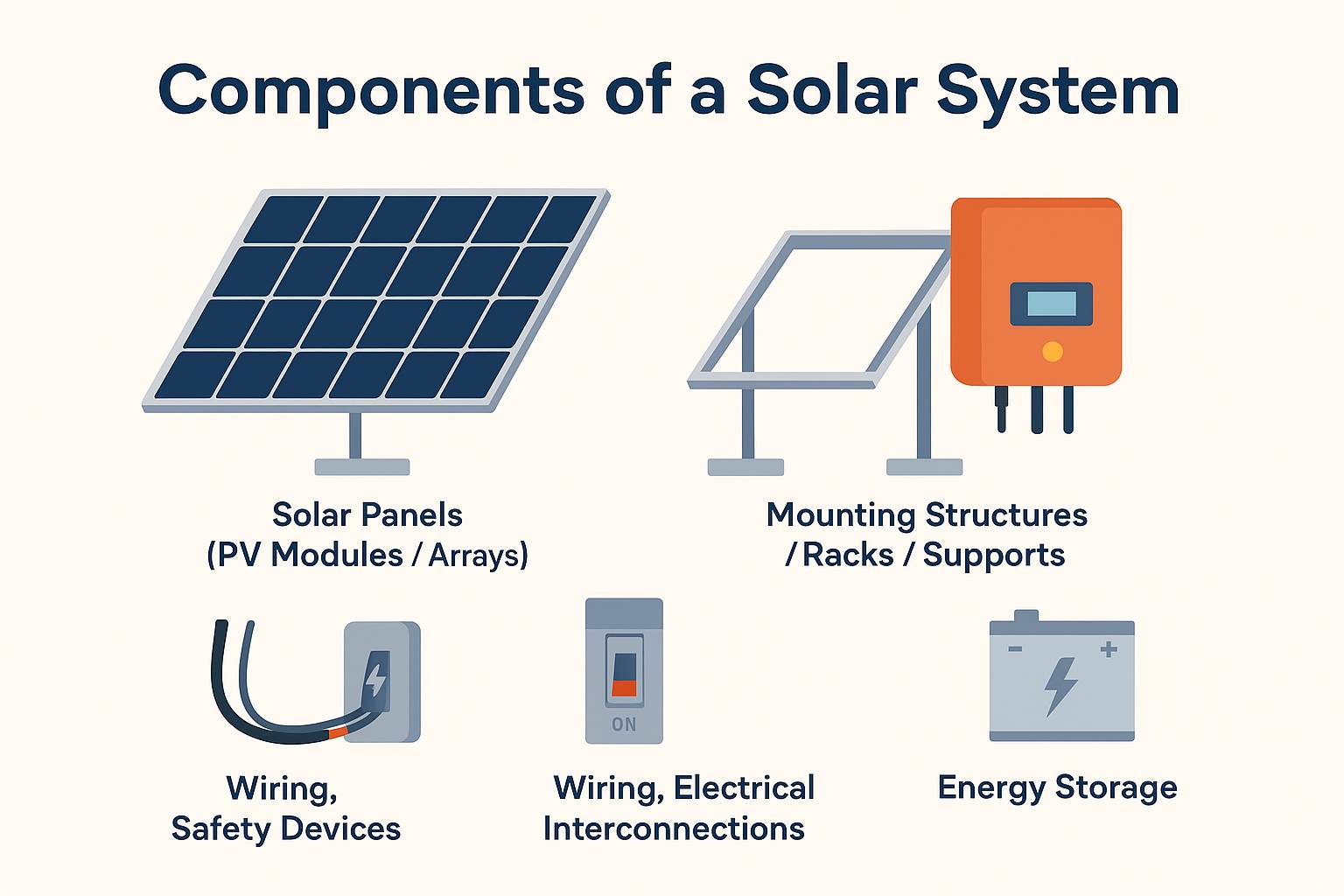
A typical solar system — whether for residential, commercial, or industrial use — breaks down into two main parts: the solar array itself (the modules that capture sunlight) and the supporting infrastructure plus electronics, collectively known as the “balance of system” (BOS).
Here are the essential components:
Solar Panels (PV Modules / Arrays)
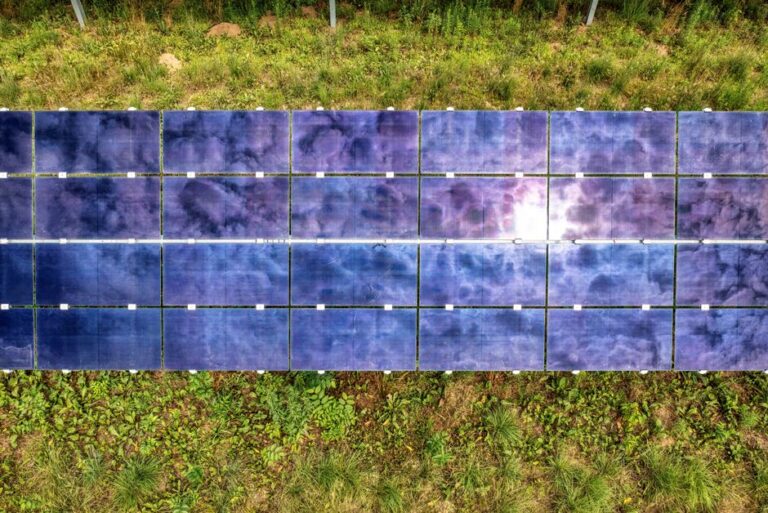
Solar panels, also called PV modules, form the core of any solar installation. They consist of multiple solar cells (often silicon-based) that convert sunlight into direct current (DC) electricity.
Panels connect to form a solar array — the larger the array, the more energy the system generates, provided all other components match accordingly.
Mounting Structures / Racks / Supports
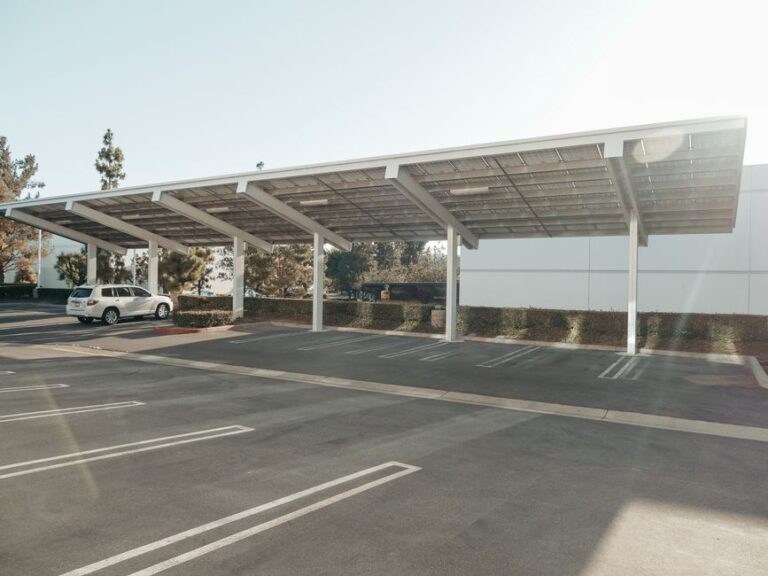
PV arrays need stable mechanical support. Mounting structures — whether rooftop racks, ground mounts, or pole/wall supports — hold the panels securely and position them at the optimal tilt and orientation to maximize sunlight capture.
For commercial or industrial installations, mounting quality determines long-term reliability: good mounts resist wind, rain, corrosion, and maintain alignment over decades.
Inverter(s)
The electricity generated by solar panels is DC. Most households, businesses, and grids operate on alternating current (AC). Inverters convert DC to AC, enabling solar-generated electricity to power appliances or feed into the grid.
Depending on system design, inverters come in various types: string inverters (for groups of panels), central inverters (for large installations), microinverters (per-panel), or hybrid inverters (often combined with battery storage).
Modern inverters often include Maximum Power Point Tracking (MPPT) to optimize energy harvest, especially under partial shading or variable sunlight.
Wiring, Electrical Interconnections & Safety Devices
Electrical wiring links the solar array, inverter, battery (if present), and load/grid. Quality wiring and connectors ensure efficient energy transfer, minimize losses, and guarantee safety.
Safety devices — such as disconnect switches, fuses, circuit breakers, surge protection, grounding, and switchgear — protect the system from electrical faults, surges, or lightning strikes.
Energy Storage (Battery Bank) — Optional but Crucial for Off-Grid or Backup
Battery storage becomes essential when the system must supply power outside sunlight hours, or provide backup during outages. Batteries store excess energy generated by the solar modules.
A charge controller (or battery management system) manages charging and discharging to prevent overcharging or deep discharging — conditions that shorten battery life.
Common battery types for PV systems include lead-acid, sealed gel, AGM, and lithium-ion variants — each with trade-offs in cost, lifespan, and maintenance.
Battery Type Comparison Table
| Battery Type | Advantages | Disadvantages |
|---|---|---|
| Lead-acid (Flooded) | Lowest upfront cost- Widely available & proven technology- Easy to recycle- Good for large-scale stationary applications | Short lifespan (2–5 years)- Requires regular maintenance (water topping)- Emits gas — needs ventilation- Heavy & bulky- Lower depth of discharge (50%) |
| Sealed Gel Battery | Maintenance-free- Better tolerance to deep discharge than flooded lead-acid- Good performance in high temperatures- No leakage, safer design | Higher cost than standard lead-acid- Slower charging time- Sensitive to improper charging (can shorten lifespan)- Moderate lifespan (3–6 years) |
| AGM Battery (Absorbent Glass Mat) | Maintenance-free- Lower internal resistance → supports higher discharge currents- Faster charging than gel or flooded lead-acid- Good vibration resistance- Spill-proof and safe | More expensive than flooded and gel batteries- Lifespan still shorter than lithium (4–7 years)- Performance decreases faster under high heat |
| Lithium-ion (LiFePO4, Lithium Iron Phosphate) | Long lifespan (8–15+ years)- High depth of discharge (80–95%)- Lightweight with high energy density- Fast charging & high efficiency (95%+)- Minimal maintenance- Stable chemistry (LiFePO₄ is very safe) | Highest upfront cost- Requires BMS (Battery Management System)- Sensitive to extremely low temperatures- Requires certified suppliers to ensure safety and cell quality |
Monitoring, Control & Optional Components
Many solar systems include monitoring equipment that tracks power generation, system performance, and alerts for maintenance. Especially for commercial or industrial installations, such monitoring helps ensure efficiency and early fault detection.
Optional components may include:
1. Maximum Power Point Tracker (MPPT) controllers (for battery-charging systems)
2. Solar trackers (single- or dual-axis) to follow the sun and increase yield for ground-mounted arrays
3. Surge arrestors, grounding systems, and power distribution equipment (for grid-tied or large-scale systems)
4. Energy management software, sensors (irradiance, weather), or additional transformer/step-up/step-down equipment — depending on system scale and use case.
Of course, we must conclude this section by acknowledging the greatest contributor—our source of energy—the Sun.
Why Many “What Are the Components of a Solar System?” Pages Fall Short?
Several existing guides oversimplify by listing only “panels, inverter, battery, mounts.” They neglect critical elements like wiring, safety gear, mounting integrity, and monitoring — all essential to a reliable system.
Some fail to distinguish between grid-tied and off-grid configurations. A battery may be optional in a grid-tied system, but necessary in off-grid or backup setups.
Many guides omit discussion of mounting structure quality and environmental suitability — but poor mounting compromises safety, alignment, and long-term durability.
Few reference authoritative data (e.g., from research institutions or energy agencies), which reduces credibility for technically-minded or B2B buyers.
This article avoids those shortcomings. It covers all essential components, clarifies system variations, and draws on recognized authoritative sources to guide sound decision-making.
How to Use This Guide — Practical Buyer Implications?
For grid-tied commercial installations, prioritize high-efficiency PV modules, robust inverters with MPPT and grid-compliance, and quality mounting plus wiring and protective devices.
For off-grid or hybrid systems, include battery storage, charge controllers, and possibly monitoring or energy management features.
Always design mounting and structural components based on site conditions (wind, climate, tilt, orientation) to ensure safety and optimal output.
Confirm all wiring, grounding, fuses, and safety devices meet local electrical codes or standards.
Specify monitoring and maintenance protocols — especially for larger installations — to preserve system health and maximize lifespan.
Final Thoughts
A complete solar system consists of much more than just panels and inverters. A fully functional, reliable, and safe system requires careful integration of PV modules, mounting structures, inverters, wiring and safety devices, optional battery storage, and—where appropriate—monitoring or control systems. Drawing on authoritative sources and covering all critical components produces a comprehensive reference. Buyers who evaluate all relevant parts — not just the obvious ones — will secure solar installations that deliver stable, efficient, and long-lasting performance.