Designing Solar Mounting Systems for Typhoon-Resistant
In many coastal regions, solar developers face a serious challenge: how to keep solar systems stable during typhoons. These storms bring high winds, driving rain, and unpredictable gusts. A single weak joint or poorly anchored frame can set off a chain reaction—panels twist, bolts loosen, and entire arrays can collapse. The result isn’t just lost equipment; it’s lost investment, downtime, and in some cases, serious safety hazards.
For those building or maintaining systems in such environments, the question isn’t if a typhoon will come—it’s when. The key to long-term reliability lies in the design and engineering of the mounting structure.
Why Structure Matters More in Coastal Areas
In ordinary inland projects, engineers mainly focus on snow load and general wind resistance. But in coastal or island environments, wind uplift and vibration become the primary concerns. During a typhoon, pressure differences under and above the panel can reach extreme levels. A weak or overly flexible structure may start to oscillate, gradually loosening bolts and joints.
To prevent this, a mounting system must:
- Distribute loads evenly across the structure.
- Resist twisting and bending caused by strong gusts.
- Use corrosion-resistant materials, since salty air accelerates metal fatigue.
Carbon Steel vs. Aluminum: Understanding the Trade-offs
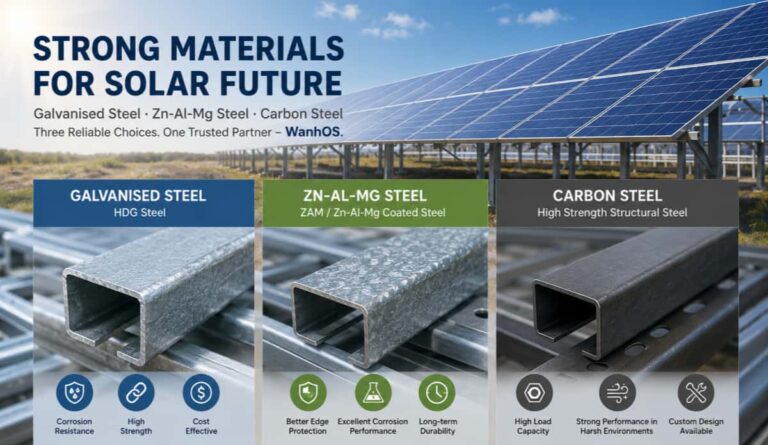
While aluminum is light and easy to install, it doesn’t always offer the stiffness needed for typhoon-level wind speeds. That’s why carbon steel systems are commonly chosen for coastal or high-wind zones.
A well-designed carbon steel structure:
- Has higher tensile strength and better resistance to deformation.
- Weighs more, which helps anchor the array naturally.
- Costs less per ton compared to aluminum.
- When galvanized or treated properly, offers excellent corrosion protection.
The trade-off is added weight during transport and installation—but for large-scale ground or flat-roof systems, that’s a manageable cost for much higher reliability.
The Importance of Structural Geometry
Beyond material choice, geometry plays a critical role. Triangular and cross-braced configurations distribute force effectively, minimizing stress at connection points. For example, Wanhos’s carbon steel system uses a reinforced triangular design with horizontal and diagonal braces that absorb torque and prevent panel misalignment under heavy wind load.
Wind tunnel testing has confirmed that properly reinforced structures can withstand wind speeds up to 60 m/s (equivalent to a Category 4 typhoon).
Getting the Foundation Right
Even the strongest frame fails if it’s not anchored properly. Foundation design depends heavily on soil type and terrain:
- Pile-driven foundations are ideal for firm, compact soil and allow fast installation.
- Ground screws work best in loose, sandy, or rocky conditions, and cause minimal environmental disturbance.
- Concrete or precast bases are used for special terrain or areas with construction restrictions.
Each foundation type changes how loads transfer to the ground. That’s why a structural analysis—considering wind, soil, and load distribution—is not optional; it’s the foundation of the entire system’s safety.
Practical Design-to-Deployment Process
For developers and EPCs working in typhoon-prone regions, the best approach includes:
- Site survey and soil testing – Understand ground stability and flood risk.
- Customized layout design – Optimize row spacing and tilt angles to reduce uplift.
- Material selection – Use galvanized or stainless-steel fasteners to prevent corrosion.
- Load simulation – Verify structural integrity through software modeling or wind tunnel testing.
- Quality installation – Follow torque specifications; a single loose bolt can compromise the whole array.
A reliable mounting partner should provide not only components but also engineering documentation, layout drawings, and structural calculations tailored to the project.
A Holistic Approach to Resilience
At Wanhos, we view the mounting system as more than a physical frame. It’s the backbone of long-term solar reliability. From material sourcing to wind-load testing, every step is designed to ensure stability in harsh conditions. Our carbon steel ground mounting systems have been successfully deployed in coastal and typhoon-affected regions, proving their strength in real-world conditions.
Whether the foundation uses piles, ground screws, or concrete blocks, each project is supported by detailed engineering analysis and on-site guidance to ensure a safe, durable installation.
Final Thoughts
Building solar in typhoon-prone regions isn’t just about using heavier steel or stronger bolts. It’s about engineering for resilience. A well-designed mounting system balances weight, geometry, material, and foundation to create a structure that can stand firm for decades.
For investors and EPC contractors, this attention to design detail is what protects not only your panels but also your long-term returns—and, ultimately, your reputation for quality.