
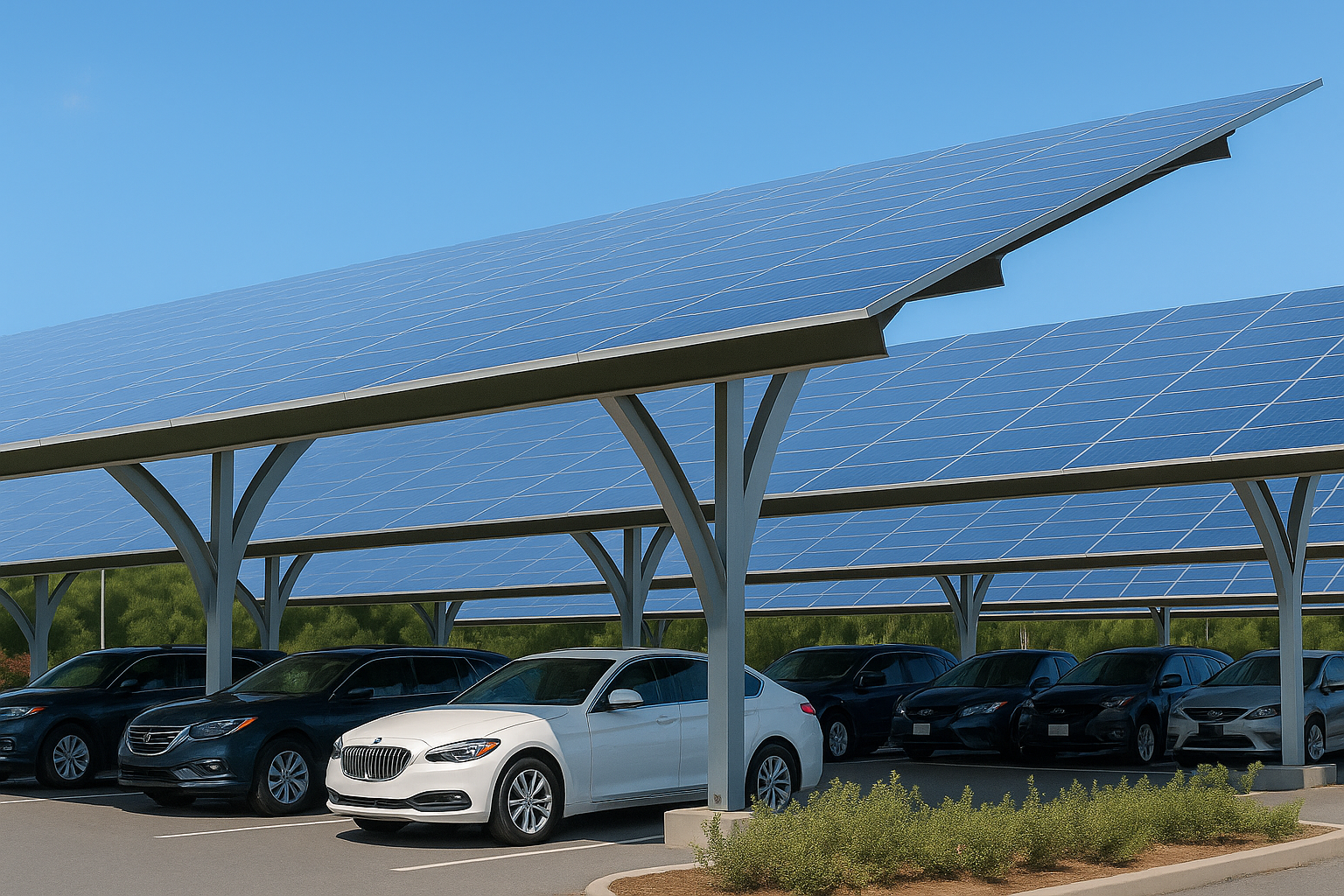
How To Choose The Right Solar Carport For Your Needs Wisely?
With the growing global demand for renewable energy, the application of photovoltaic energy in charging stations has become a research hotspot. In the context of electric vehicle charging stations, integrating solar energy not only helps improve energy self-sufficiency but also optimizes grid operation through energy storage systems, enhancing the cost-effectiveness and environmental friendliness of charging stations. So how to choose the right solar carport for your needs wisely? Wanhos Solar has reviewed and summarized the operating principles, structural types, investment returns, and impacts of solar carports on charging stations to help investors choose the most suitable carport design!
Definition of a Solar Carport
A solar carport combines solar PV modules with a carport roof and is the simplest form of building-integrated photovoltaic (BIPV) (Building Integrated Photovoltaic) (BIPV) technology. It not only performs all the functions of a traditional carport but also generates electricity and generates revenue for the owner. We can even combine with energy storage batteries and charging stations to create a comprehensive solar + storage + charging solution.
How a Solar Carport Works?
How to choose the right solar carport for your needs wisely? First, knowing the solar carport is very important. A solar carport utilizes solar panels mounted on the roof to absorb sunlight and convert it into direct current (DC) electricity. An inverter then converts the DC power into AC power for use in the carport or for charging devices such as electric vehicles.
Each carport has a combiner box beneath it. The solar panels on the rooftop collect and store the electricity they absorb. The electricity is then transmitted to an inverter, which converts DC power into AC power for transmission to the grid, generating electricity. However, for typical solar-storage-charging stations, the electricity generated by photovoltaics is primarily self-generated and consumed.
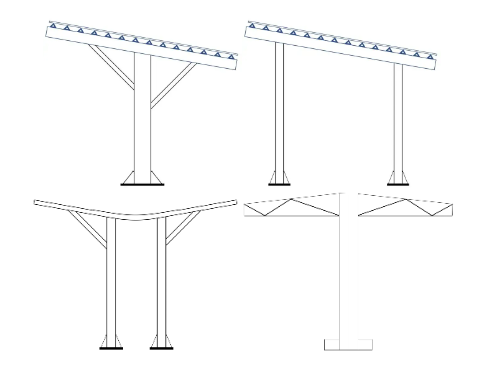
Components of a Solar Carport
- PV Modules
We primarily install solar panels on the rooftop of the carport, converting solar energy into electricity. We can choose monocrystalline silicon, polycrystalline silicon, or thin-film solar cells as solar panels, depending on specific needs.
- Inverter
This inverter converts the DC power generated by the PV modules into AC power for integration into the grid or supplying power to loads. The inverter must have high conversion efficiency and reliable performance.
- Power Distribution System
It includes distribution boxes, cables, and other components, and we use it for the transmission and distribution of electrical energy. It must comply with electrical safety regulations to ensure safe and reliable power transmission.
- Charging Facilities (Optional)
We usually equip many solar carports electric vehicle charging stations, utilizing solar power generation to charge electric vehicles, further improving green energy efficiency.
- Monitoring System (Optional)
Real-time monitoring of the solar carport’s power generation, operating status, and other data facilitates operation, maintenance, and management.
Photovoltaic Carport Structural Types
We categorize the solar carports by the number of columns into single-column, multi-column, and BIPV waterproof types. Based on the slope shape, we categorize them into single-slope, double-slope, flat-top, and curved types. Based on whether we use PV structural components, we categorize them into attached and constructed types. Based on the overall structural material, we categorize them into concrete, aluminum, and steel. Based on their function, we categorize them into conventional and smart carports.
Classification by the Number of Columns
Single-column photovoltaic carports: The main advantage of single-column carports is their simple structure, which saves significant space, provides greater parking convenience, and is easy to install and construct.
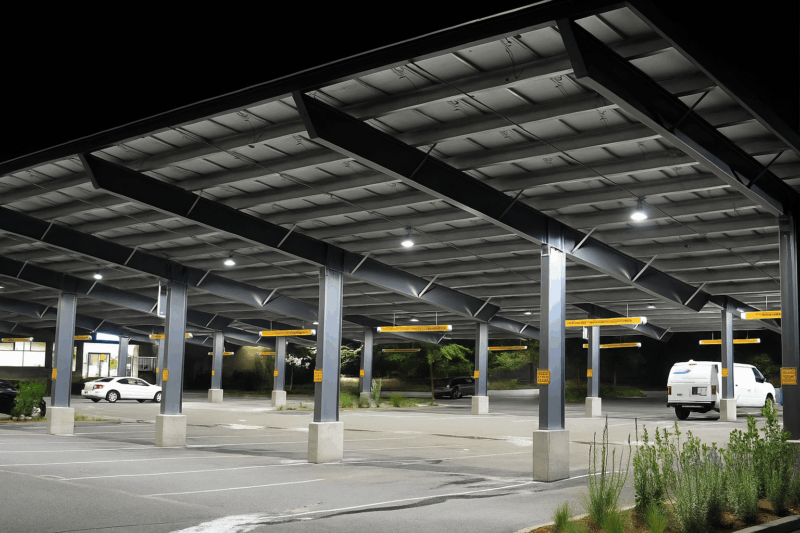
Multi-column PV Carports: We construct multi-column carports entirely of aluminum alloy, resulting in a simple structure. Compared to single-column carports, their overall structure offers greater safety and stability, stronger wind resistance, and significantly improved space utilization. However, due to the increased material usage, their overall cost is slightly higher than that of single-column carports.
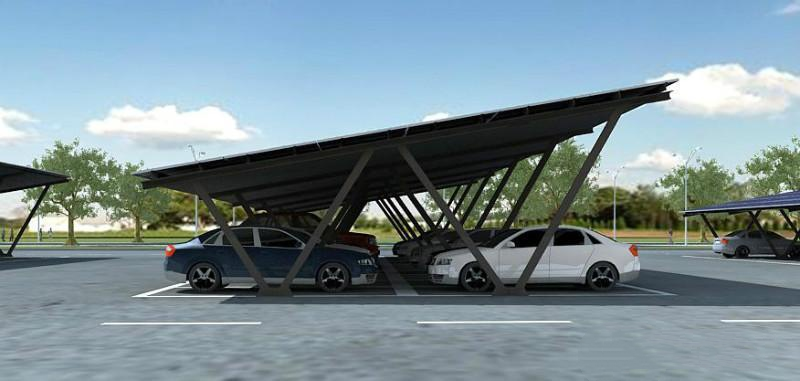
BIPV Waterproof PV Carports: BIPV waterproof PV carports incorporate a waterproof structure based on conventional PV carports. This innovative waterproofing system, combined with a water channel, effectively eliminates water seepage and offers excellent waterproof performance. The main support structure utilizes a mechanically stable “double ▽” structure, ensuring a stable structure. The concealed concrete pier design saves space and facilitates parking.
Based on the Slope Shape
Single Slope: A single-sided slope design, typically with one side higher than the other, facilitates drainage and PV panel installation. This simple structure offers a lower cost and is suitable for small and medium-sized carports. Suitable for north-south orientations, it is ideal for residential parking spaces and small commercial parking lots.
Double-slope: A double-slope design, similar to a traditional gable roof, maximizes solar energy utilization. While structurally complex, it’s aesthetically pleasing and practical, making it suitable for large-scale PV installations. It’s primarily used in large commercial and corporate parking lots and is suitable for east-west orientations.
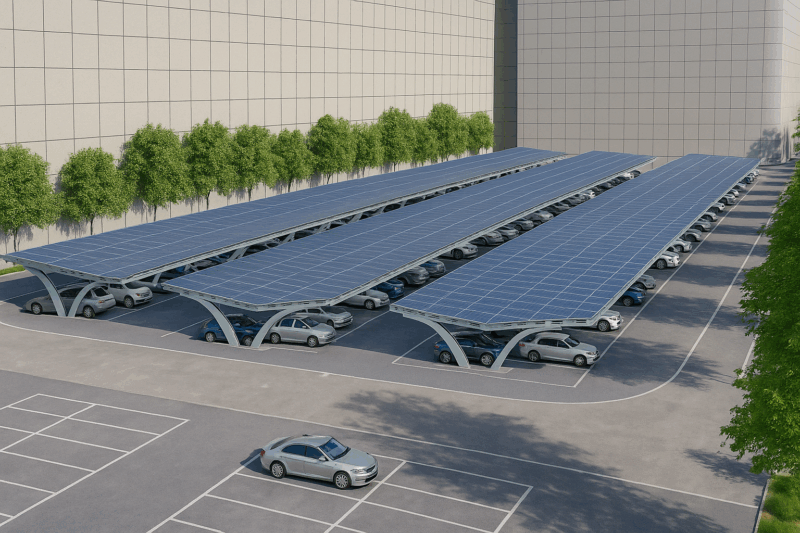
Flat-roof: We install a flat-roof design with PV panels typically parallel to the ground. This allows for easy installation and is suitable for sites with limited space, but drainage requires special consideration.
Curved: A curved design, typically featuring an arc or wavy structure, offers a modern and aesthetically pleasing appearance. While complex and costly, it provides excellent visual appeal and sunshade performance.
Whether the PV panels are used as structural components
Attached: Suitable for retrofitting existing carports.
Constructed: We incorporate PV panels into the carport’s structural components, resulting in a simple and aesthetically pleasing design.
Based on the overall structural material of the carport
Concrete PV carports: Concrete PV carports utilize an underground cast-in-place foundation. We connect the roof securely to the front and rear columns using precast U-bolts. C-shaped steel crossbeams are then installed to meet wind load requirements. Then we mount PV racks and panels on the C-shaped steel. Panels can be positioned at the optimal angle to maximize power generation.
Aluminum PV carports: Aluminum PV carports have three sets of columns above ground. The lowest point of the tilted aluminum structure is greater than 2.5 meters above the ground. The installation angle is approximately 10 degrees.
Steel PV carports: Single-column steel PV carports have two sets of steel columns above ground. The lowest point of the tilted steel structure is greater than 2.5 meters above the ground.
Based on function
Conventional carports: These only function as photovoltaic power generators.
Smart carport: Added functions such as energy storage, charging piles, and intelligent management, with better economic and environmental benefits and more comprehensive service functions.
So how to choose the right solar carport for your needs wisely? Above all are the answer for most common situation. If you are interested in knowing more or sharing insights with us, please feel free to contact.


