How Far from a House Can Ground-Mounted Solar Panels Work?
When people think of solar energy, they often picture panels on rooftops. However, ground-mounted solar systems are a practical alternative, especially for properties with open land or roofs unsuitable for solar installation. One of the most common questions homeowners ask is: “How far from my house can ground-mounted solar panels actually work?”
The answer involves more than just physical distance, it depends on wiring, voltage, efficiency, and safety standards.
The Role of Distance in Solar Power
Solar panels generate direct current (DC) electricity, which must travel through cables to reach the inverter, where it is converted into alternating current (AC) for household use. The farther the panels are from your house:
- The longer the cables need to be.
- The greater the potential for voltage drop (loss of energy as heat in the wires).
- The higher the cost for cabling and trenching.
Thus, distance doesn’t make solar “stop working,” but it affects efficiency, design, and cost.
Voltage Drop Explained
Voltage drop refers to the reduction in electrical pressure as current travels through a wire.
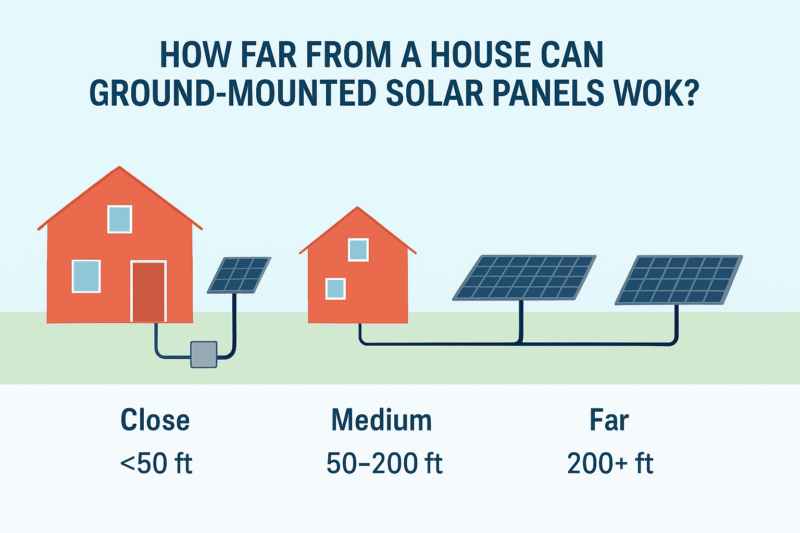
- Short runs (under 50 feet / 15 meters) usually have minimal loss.
- Medium runs (50–200 feet / 15–60 meters) may require thicker gauge wires to compensate.
- Long runs (200+ feet / 60+ meters) can still work, but efficiency losses and installation costs increase significantly.
Rule of thumb: Solar designers try to keep voltage drop below 2–3% for optimal performance.
Design Strategies for Longer Distances
If your panels need to be placed far from the house, engineers can use several strategies:
- Higher System Voltage
Running the solar array at 600V, 1000V, or even 1500V DC (common in commercial systems) reduces current, which minimizes voltage drop.
- Thicker Cable Sizes
Larger diameter cables carry current more efficiently over long distances but are more expensive.
- AC-Coupled Systems
Placing the inverter close to the solar array converts DC to AC on-site, and AC power travels better over long distances.
- Energy Storage Near the Array
In hybrid systems, batteries and inverters can be installed next to the ground-mounted array, and only AC output is sent to the home.
Practical Distance Guidelines
- Typical residential systems: Panels are usually within 50–100 feet (15–30 meters) of the house.
- Extended layouts: With proper design (thicker cables, higher voltages), arrays can be placed 300–500 feet (90–150 meters) away.
- Large properties/farms: Utility-scale systems often place solar fields thousands of feet away, but they use specialized inverters, transformers, and underground cabling.
So, for a homeowner, a few hundred feet is generally practical if engineered correctly. Beyond that, costs may outweigh benefits unless the system is large.
Other Considerations
- Shading: Ground-mounted systems should be positioned for maximum sun exposure, even if it means being farther from the house.
- Local Codes: Electrical codes (like NEC in the U.S.) dictate allowable voltage drops and wiring practices.
- Trenching Costs: Excavating to bury long cable runs can add significant expense.
- Maintenance Access: Locating the system too far from the house might complicate monitoring and servicing.
Summary
Ground-mounted solar panels can work effectively even when placed far from a house. In most residential projects, keeping the distance within 100 feet is ideal. But with proper engineering, such as thicker wires, higher voltages, or local inverters, systems can be placed several hundred feet away without major performance loss.
In short, it’s not about whether panels “can” work far from the house, but how efficiently and cost-effectively they can do so. Consulting a professional solar mounting company ensures the system design strikes a balance between efficiency, safety, and budget while maximizing solar potential.