Helical Screw Piles vs. Concrete Foundations: Which Is Best for Your Solar Farm?
If you want the honest engineering answer first, here it is: neither helical screw piles nor concrete foundations are always “best” for a solar farm. The better choice depends on what your site can actually support, how fast you need to build, how much civil work your budget can tolerate, and how much construction risk you are willing to carry into the field. Safe and reliable PV deployment depends on getting the codes, standards, and structural decisions right from the start, not on defaulting to one foundation type out of habit.
From a product manager’s perspective, this decision affects procurement, schedule, installation speed, and downstream warranty confidence. From an engineer’s perspective, it is even simpler: your solar farm foundation has to transfer compression, uplift, and lateral loads into the ground in a way the soil, the structure, and the project timeline can all live with. ICC-ES evaluation reports for helical systems explicitly describe them as deep foundations designed to transfer compression, tension, and lateral loads to suitable bearing strata, while FHWA and ACI guidance show that concrete foundation systems such as drilled shafts or piers remain standard, heavily engineered solutions where excavation, concrete placement, and site-specific subsurface conditions are central to performance.
Why This Question Matters More on Solar Farms Than Many Teams Expect
On a solar farm, foundations are rarely just a line item in the BoQ. They influence pile layout, mounting tolerances, equipment mobilization, weather risk, construction sequencing, and even how quickly mechanical crews can move behind civil crews. A foundation decision that looks cheap on paper can become expensive if it slows the schedule, creates rework, or forces field adjustments across thousands of posts. That is why experienced EPC teams usually treat foundation selection as a geotechnical and execution decision, not simply a materials decision.
The mistake I see most often in solar content is that people compare helical screw piles and concrete foundations as if they were interchangeable products. They are not. They solve the same structural problem in very different ways, and those differences show up quickly once soil conditions, water table, temperature, access, and installation method enter the conversation.
How Helical Screw Piles Work in Solar Applications
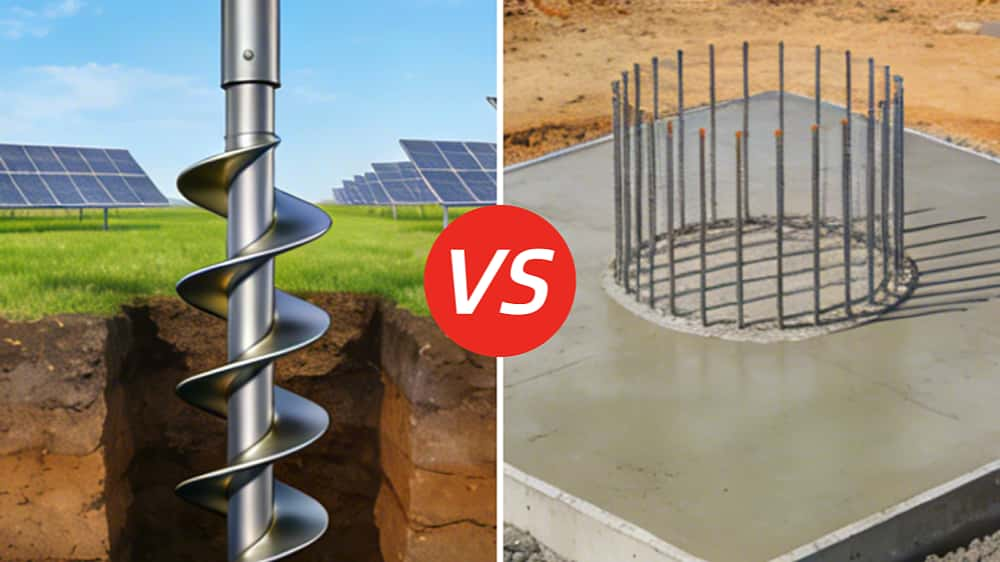
A helical screw pile is essentially a steel shaft with one or more helical plates that are rotated into the ground. Technical guidance and ICC-ES documentation describe helical systems as deep foundations that can be extended with shaft sections and used to transfer compression, uplift, and lateral loads into suitable soil. In practical solar terms, that means the foundation can often be installed with relatively compact equipment and then connected into the mounting structure without waiting for concrete curing.
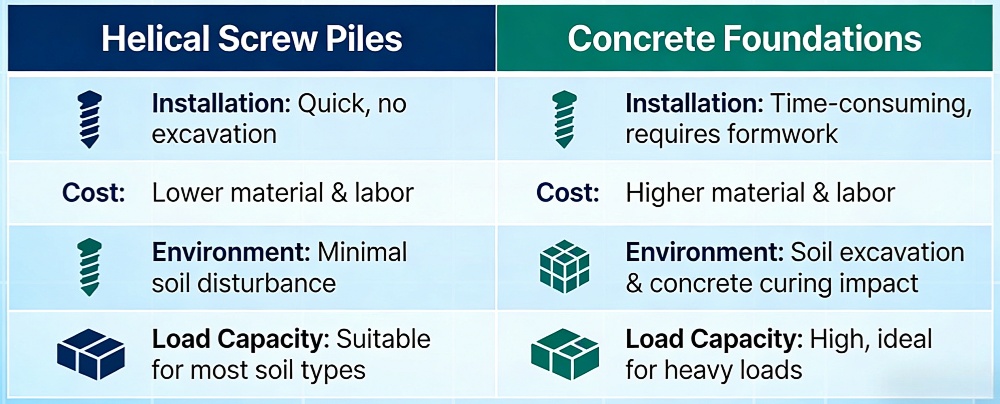
That last point is where helical piles become commercially attractive. Engineering manuals and implementation guides consistently note that helical piles can be loaded immediately after installation, do not require the cure time associated with concrete, and are often installed with smaller, more maneuverable equipment than many other deep foundation systems. For a solar developer trying to protect schedule float, that is not a small advantage. It can completely change how quickly the project moves from civil work to structure assembly.
How Concrete Foundations Work in Solar Farm Construction
Concrete foundations cover a few different approaches, but on utility and commercial solar sites the conversation usually involves concrete footings, piers, or drilled shafts. ACI’s drilled pier specification makes clear that these systems involve excavation, possible use of casing or liners, reinforcement placement, concrete properties and placement, inspection, and quality control. FHWA’s drilled shaft guidance likewise treats them as a full construction and design system rather than a simple pour-and-go solution.
Concrete also brings curing into the schedule, and curing is not a minor detail. ACI’s curing guidance states that external curing procedures are essential to help cast-in-place concrete achieve intended performance, while ACI’s cold-weather guidance stresses that concrete placed in cold conditions must be protected against freezing and properly cured for sufficient time. In other words, a concrete foundation is not just about forming and pouring. It is about controlled construction conditions after placement as well.
When Helical Screw Piles Usually Have the Advantage
If your project is schedule-sensitive, logistically constrained, or trying to reduce site disturbance, helical screw piles often deserve serious attention. Because they can be installed with lighter equipment and loaded immediately, they are especially attractive on sites where you want to keep civil operations moving without waiting on curing windows. That is one reason helical systems are often positioned as accelerated-construction solutions in engineering and implementation guidance.
They are also a practical fit when access is limited or when a project team wants to avoid extensive excavation and concrete handling. That does not make them automatically right for every site, but it does make them operationally appealing on solar farms where repetition, speed, and predictable installation matter. If you are building on a site where equipment mobilization, weather windows, and crew sequencing drive profitability, screw piles can be a very strong option.
Another advantage is winter or shoulder-season scheduling. Helical systems are not dependent on concrete curing, while ACI’s cold-weather guidance makes clear that concrete placement in freezing conditions requires protection and process control. For a project team trying to keep crews working through colder periods, that difference can materially affect planning and cost.
When Concrete Foundations Still Make Sense
Concrete foundations still make sense when the project needs a conventional, highly familiar foundation path that local civil crews, inspectors, and design teams already know how to detail and execute. They are also relevant when the design logic already points toward drilled shafts, grade beams, or reinforced concrete elements as part of the broader structural concept. FHWA and ACI guidance both reflect how established and deeply codified these systems are in foundation engineering practice.
There is also a practical reality here that many procurement teams underappreciate: not every site uncertainty disappears just because screw piles are fast. Helical pile design still depends on geotechnical understanding, torque-capacity relationships, and installation termination criteria. Where subsurface conditions are uncertain, additional investigation or helical test probes may be needed to validate feasibility and design assumptions. That does not mean helical is a poor choice. It means the site still gets the final vote.
From an engineering standpoint, concrete is often chosen not because it is elegant, but because it is familiar, defensible, and well understood by the parties approving the project. Sometimes that familiarity has real value, especially on risk-averse projects or in markets where permitting and contractor habits still lean heavily toward conventional foundation methods.
Cost Is Bigger Than the Foundation Material
This is where buyers can get misled. If you compare only the material or fabrication price, you may miss the real project economics. Helical screw piles often reduce excavation, spoil handling, cure-related waiting, and some equipment burden. Concrete foundations may carry more steps through excavation, rebar, concrete placement, curing, and cold-weather protection if conditions require it. That means the true comparison is total installed cost plus schedule impact, not just the price of steel versus concrete.
As someone thinking like a product manager, I would frame it this way: ask which foundation helps your project move with fewer handoffs, fewer weather sensitivities, and fewer surprises between design intent and field reality. The cheapest foundation is usually the one that behaves predictably across the whole site, not the one with the lowest unit price on day one. That is an inference from how these systems are constructed and controlled, but it is exactly how real project margins get protected.
What Engineers Usually Check Before Choosing
A serious foundation decision for a solar farm starts with subsurface data, structural loads, corrosion exposure, groundwater conditions, and installation logistics. For helical systems, engineers need to understand whether the soil profile supports the selected shaft and helix configuration and whether installation torque and termination criteria will be reliable. For concrete systems, the team needs to think through excavation stability, concrete placement quality, curing, and how site conditions affect the drilled pier or footing process.
That is why the best answer to “helical screw piles vs. concrete foundations” is rarely a generic blog answer. It is usually a site-specific answer supported by geotechnical data and installation logic. In practice, the wrong foundation is often the one selected too early, before enough field information exists.
How Xiamen Wanhos Solar Technology Co., Ltd Looks at the Decision
At Xiamen Wanhos Solar Technology Co., Ltd, the useful way to think about this comparison is not “which foundation sounds better in marketing,” but “which foundation gives the solar farm a cleaner path from design to installation to long-term stability.” On some sites, that points to helical screw piles because schedule, access, and reduced wet work matter most. On others, concrete foundations remain the more comfortable path because the project team, local market, or structural concept is already built around them.
That kind of decision-making is where engineering support matters. Buyers do not just need a mounting supplier. They need a partner that understands how foundation choice affects the entire ground-mount system, from layout accuracy and structural interfaces to installation planning and project risk.
Which Choice Pays Off Better Over the Life of the Project
If the site supports them, helical screw piles are often the stronger choice for solar farms that value speed, simpler logistics, immediate loading, and reduced dependence on curing conditions. If the project requires a more conventional civil path, or if site conditions and approval culture favor reinforced concrete work, concrete foundations can still be the better answer. Neither option wins by default. The site data, the construction sequence, and the risk profile decide it.
That may sound less dramatic than a one-size-fits-all answer, but it is the answer that actually helps developers, EPCs, and procurement teams avoid expensive mistakes. In solar, the best foundation is the one your geotechnical data, construction team, and structural design can all defend at the same time.