Ballasted Roof Solar Mounting Without Roof Penetration: What Still Needs Engineering Review

When a roof membrane must stay watertight and mechanical fasteners are off the table, ballasted roof solar mounting becomes the logical path. But before you start stacking concrete blocks, there are site-specific factors that separate a safe installation from a costly mistake.
Key Takeaways
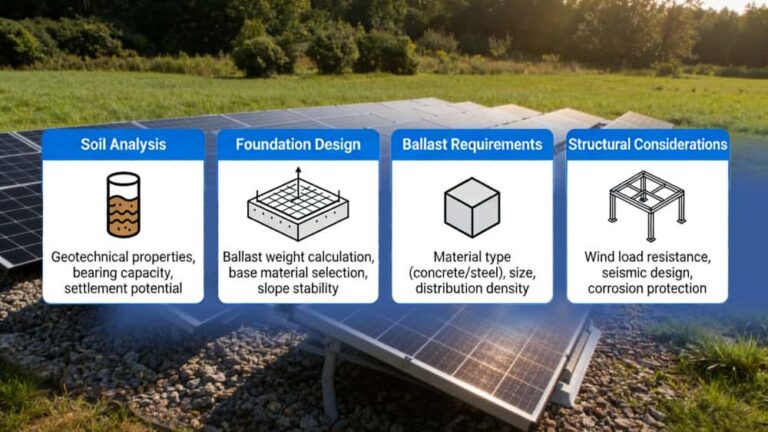
- Ballasted systems eliminate roof penetrations but add significant dead load that must be verified against the existing roof structure.
- Wind uplift is the primary engineering challenge; ballast weight calculations must consider edge zones, roof height, and local wind codes.
- Pre-assembled tray systems can speed installation, but ballast layout, drainage, and membrane protection still need careful field execution.
How Ballasted Roof PV Systems Actually Stay Put
Unlike penetrating flat-roof mounts that transfer tensile and shear forces into the roof deck, a ballasted array relies entirely on hold-down weight and friction. The basic concept is simple: place enough mass on the mounting structure so that the total downward force exceeds the wind uplift force that tries to lift and slide the modules.
In practice, that weight usually comes from precast concrete blocks placed at designated points on the racking. Some systems use modular trays that integrate the ballast pan directly into the aluminum frame, while others use long rails with concrete blocks clamped or simply rested on top. East-west oriented systems with low tilt (5°–10°) often require less ballast because the aerodynamic profile is lower than south-facing tilted racks, but the trade-off is a slightly lower energy yield per watt installed.
Friction between the structure and the roof surface is equally important. A smooth TPO membrane offers less grip than a roughened EPDM or built-up roof. In many designs, a rubber or EPDM slip sheet is placed under the ballast blocks not to increase friction, but to protect the membrane while still allowing micromovement from thermal cycling. True friction pads, when specified, can reduce required ballast weight by improving the coefficient of friction to around 0.6–0.8 on clean surfaces, but they must be compatible with the roofing material to avoid chemical degradation over time.
The Engineering Review Checklist Before You Approve a Ballasted Design
Calling a mounting system “ballasted” doesn’t make it a one-size-fits-all answer. Every roof needs a pile of site data reviewed by someone who understands both solar and structural loads. Here’s what should be on the table before ordering materials.
Wind Uplift Calculation (Not Just a Guess)
Wind load governs ballast weight, and it changes dramatically across the roof field. Perimeter and corner zones see up to 3–4 times the uplift pressure of the interior zone. A design that only uses a single ballast weight across the whole array without zone-specific adjustments is a red flag. Wind tunnel test data for the specific mounting geometry is the most reliable input, but in many projects, engineers work with ASCE 7, Eurocode 1, or local building standards, applying appropriate safety factors (usually 1.5 or higher).
A realistic ballast weight for a south-facing 10° tilted system in a moderate wind zone might be 60–90 kg per panel in the interior and over 150 kg near corners. East-west tray systems can cut that by 20–30% because their shape creates less net uplift, but they concentrate more load along fewer support points, which shifts the load distribution concern to the roof deck.
Roof Structural Capacity and Dead Load
Adding 15–25 kg/m² of dead load from the combined weight of modules, racking, and ballast can exceed the reserve capacity of an older roof or a roof not originally designed for solar. A structural review must account for existing roofing materials, insulation board compressive strength, and steel deck or concrete slab load limits. Ballasted systems can be a poor choice on EPS-based roof assemblies where point loads under concrete blocks can cause long-term indentation and local water ponding.
Slope, Drainage, and Parapet Effects
Ballasted arrays work almost exclusively on flat roofs with a slope under 5–7 degrees. Above that, gravity components acting parallel to the roof surface can create a sliding force that friction alone may not resist without additional lateral restraint. Drainage paths must be kept open. Rows of ballast blocks set perpendicular to the slope can trap water and organic debris, accelerating membrane aging. The array layout should include at least 50 mm gaps between ballast rows to allow water flow.
Where Ballasted Mounting Makes Sense – and Where It Doesn’t
Ballasted systems are a strong candidate when roof penetrations are forbidden by warranty or building owner instruction, when the roof is a thick concrete deck with plenty of load reserve, and when the PV system size is large enough to justify the engineering effort. They become problematic on lightweight membrane roofs over thin-gauge steel decks, on roofs with many penetrations that force awkward ballast placement, or in high-wind regions where the required concrete weight makes the total load impractical. No ballasted design can completely escape adding mass, so if the structure can’t handle it, penetration-based systems with structural attachments become the fallback.
Ballasted vs. Penetrating Flat Roof Mounting: Where the Real Differences Lie
The decision often comes down to roof condition, wind zone, and warranty requirements. The table below highlights what changes site-by-site.
| Factor | Ballasted System | Penetrating System |
|---|---|---|
| Roof Penetration | None | Mechanical fasteners through membrane |
| Typical Dead Load Addition | 15–30 kg/m² (can vary widely) | 3–8 kg/m² |
| Wind Uplift Resistance | Relies on weight; requires precise calc | Transfers load to roof structure; can be very high |
| Installation Speed | Faster if trays are pre-assembled; ballast positioning needs crane or labor | Requires locating and sealing each penetration; slower on sensitive roofs |
| Roof Warranty Impact | Preserves warranty when done with owner’s protective measures | Often requires roofer involvement or may void sections if not done correctly |
| Suitable Roof Types | Concrete, heavy steel deck with robust membrane; low-slope only | Most commercial roof types, including those with limited load reserve |
Installation Details That Affect Long-Term Performance
Even after engineering is signed off, mistakes during installation can turn a ballasted array into a maintenance headache. These are the details that separate trouble-free systems from ones that need regular rework.
Slip Sheets and Membrane Protection
Always use a manufacturer-specified separation layer under concrete blocks. Direct block-to-membrane contact can wear through the roofing over a few thermal cycles, especially on dark surfaces that heat up. EPDM or PVC-compatible fleece-backed slip sheets work well. Never use low-cost polyethylene sheets that can stick to warm membrane and tear during block adjustment.
Drainage and Water Management
Standing water accelerates membrane degradation and can add unexpected weight during heavy rain. Ballast layout must allow clear drainage channels toward roof drains or scuppers. Where east-west tray systems leave no gap underneath the panels, verify that the roof slope doesn’t cause water to back up behind the first row.
Thermal Movement and Component Stress
Aluminum rails expand and contract with temperature. On a 50-meter row, a 60°C temperature swing can create about 35 mm of thermal movement. Ballasted systems must allow the racking to slide slightly without dragging blocks out of position. Clamps that rigidly fix modules at both ends of a long row can buckle modules over time if expansion is constrained. This is why many ballasted designs float the whole structure on the membrane with only a few positional restraints, typically near the center of the array.
Engineering Tip: Offload Roof Drainage Before Installing Ballast Block
Before placing any concrete blocks, clear all existing drainage paths of gravel, debris, or old equipment leftovers. A ballasted array will cover part of the roof, so the remaining free area must drain well. Rooftop drains under the array need permanent access for inspection, even if that means leaving a ballast-free zone 600 mm wide around each outlet.
What to Inspect After Storms and Every Maintenance Cycle
Ballasted systems shift. It’s not a question of if, but how much and where. Routine inspection after high-wind events is more critical for ballasted arrays than for penetrating systems because there is no positive mechanical attachment holding things in place.
- Check that concrete blocks have not moved relative to marks on the slip sheet or rail. Even a few centimeters of displacement can disrupt load distribution.
- Look for compression marks or cuts under blocks on the membrane, especially near corners where uplift force acts upward.
- Scan for ponding water that indicates settling of the roof insulation under continuous ballast load.
- Verify that modules haven’t tilted or twisted. A shifted block on one side can tilt an entire string, leading to microcracks in modules over time.
- Examine any corrosion on fasteners or aluminum parts, particularly in coastal environments. SUS304 stainless steel hardware is the minimum for ballasted systems near salt spray.
Frequently Asked Questions About Ballasted Roof Solar Mounting
What is the maximum roof slope for a typical ballasted system?
Most standard designs work up to 5° (about 9% slope). Specialized systems with high-friction pads and lateral stops can handle up to 10°, but above that, mechanical attachment usually becomes necessary to resist sliding.
How is ballast weight determined for a specific project?
The starting point is wind load calculation using local building codes (ASCE 7-16 for the US, EN 1991-1-4 for Europe) or, ideally, wind tunnel test data for the exact array geometry. The engineer calculates uplift force per panel and specifies a concrete weight with a safety factor (commonly 1.5 to 2.0). Zone maps from wind tunnel studies are used to assign different ballast amounts to corner, edge, and interior zones.
Can I install ballasted mounting on a gravel-topped roof?
You can, but loose gravel underneath slip sheets can shift and puncture the membrane. The common approach is to carefully remove gravel under the array footprint, install a protective mat, and then place the ballast blocks directly on the mat. Gravel in other areas can remain to provide weighting for the roof itself.
Do ballasted systems damage the roof membrane over time?
If a proper slip sheet is used and the roof structure doesn’t deflect excessively, membrane damage is minimal. However, point loads from concrete blocks can indent soft insulation boards, which may later cause water to pool. A compressive strength check of the insulation is part of a good engineering review.
Are ballasted racking systems compatible with metal roofs?
No. Ballasted systems are designed for low-slope membrane roofs (TPO, EPDM, PVC, BUR) on a structural deck. Metal standing-seam or corrugated roofs require clamp-based or rail-less penetrative attachment and cannot support the distributed weight of a ballast system effectively.
Before You Specify a Ballasted System
Ballasted roof solar mounting avoids roof penetrations, but it trades that benefit for a heavier dead load and a strict dependency on wind engineering. The right time to consider it is when the building owner demands zero penetrations, the roof deck can handle the extra weight, and you have enough site data to calculate wind uplift zone by zone rather than treating the whole roof the same.
In projects where those conditions align, pre-engineered ballasted tray solutions—using corrosion-resistant AL6005-T5 aluminum profiles and SUS304 stainless steel hardware—can simplify installation while maintaining long-term reliability. Wanhos provides ballasted mounting structures designed with integrated drainage gaps, adjustable ballast positioning, and membrane-friendly base interfaces. If you’re evaluating whether your flat-roof project fits a ballasted approach, share your project details, module size, expected tilt, and local wind zone with a mounting system provider early. That conversation often determines whether ballasted, penetrating, or a hybrid solution will work best before the structural engineer even starts.
“`