Design Standards for Ballasted Ground Mount Solar Systems on Challenging Soils
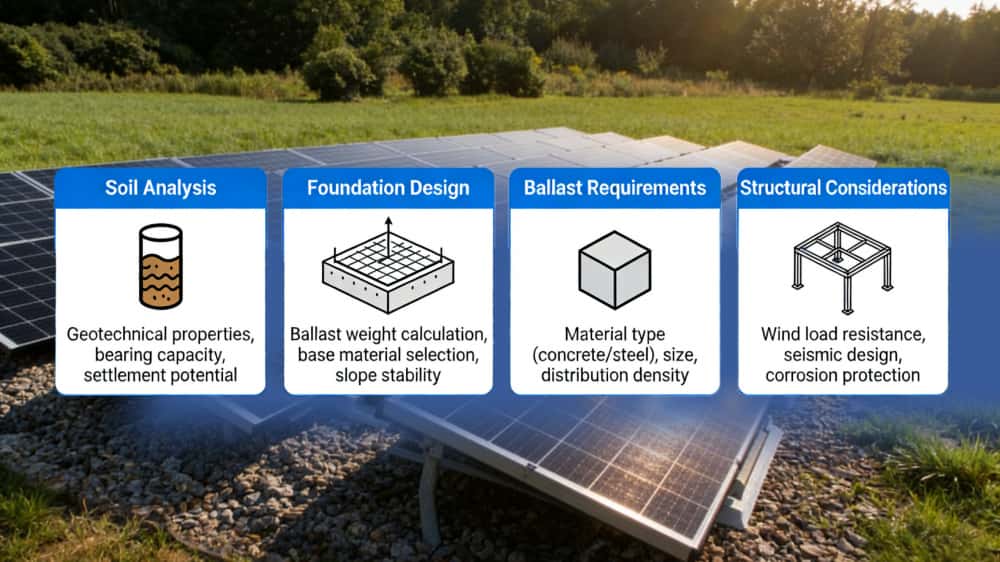
If you want the short engineering answer first, here it is: a ballasted ground mount solar system only works well on difficult soil when the project is designed like a shallow foundation system, not like a standard racking package with extra weight added later. That means the real design work starts with geotechnical investigation, code-based load combinations, and checks for bearing capacity, settlement, sliding, overturning, groundwater effects, frost, and soil movement risks such as collapse or expansion. In other words, on challenging soils, ballast is never “just ballast.” It is part of the foundation.
Why ballasted ground mounts need a different design mindset
From an engineering standpoint, a ballasted ground mount behaves much closer to a shallow foundation than to a driven-pile support. FHWA’s shallow-foundations guidance describes shallow foundations as systems that distribute structural loads over larger areas of near-surface soil or rock so the applied pressure stays within what the ground can tolerate. That is exactly the lens designers should use when evaluating ballasted solar on weak, variable, or moisture-sensitive soils.
This is also why the usual “can the rack hold the module” question is too small. A better question is whether the entire soil-foundation-racking system will remain serviceable over time. On solar sites, excessive settlement may not cause a dramatic collapse, but it can create row misalignment, drainage problems, cable stress, and long-term O&M headaches that are much more expensive than they looked during procurement. FHWA’s guidance is blunt on this point: allowable bearing values are often controlled by deformation and differential settlement, not just ultimate strength.
The standards framework usually starts with codes, then moves into soil
The broad code framework is not optional. The U.S. Department of Energy notes that safe and reliable PV deployment depends on the foundational codes and standards that govern solar installation. For structural loading, ASCE 7 remains the core reference because it prescribes design loads and load combinations for hazards including dead, soil, flood, snow, rain, seismic, and wind. On the building-code side, Chapter 18 of the IBC governs soils and foundations and requires geotechnical investigations where the code triggers them.
For practical project work, this means a ballasted ground-mount design on difficult soil should be built around at least three layers of standards logic. First, structural loads and combinations must be established under the governing jurisdictional code, often ASCE 7 plus the adopted building code. Second, the subsurface model must be based on proper soil classification and investigation. Third, the ballast base, concrete units, fill, and corrosion environment have to be checked against the relevant material and geotechnical standards rather than assumed from a catalog drawing.
Soil classification and investigation come before layout optimization
A surprising number of solar teams still try to optimize table spacing before they really understand the ground. That order should be reversed. ASTM D2487 states that soil classification based on particle-size characteristics, liquid limit, and plasticity index is a useful first step in geotechnical investigation because the soil groups correlate, in a general way, with engineering behavior. If the soil model is wrong, every later choice about ballast size, foundation footprint, and tolerable movement is built on weak assumptions.
The code side points the same way. The IBC requires that geotechnical investigations involving in-situ testing, laboratory testing, or engineering calculations be conducted by a registered design professional where required. On challenging sites, FHWA guidance also emphasizes identifying groundwater conditions and their seasonal variation, because water level can materially change effective stress and therefore shallow-foundation performance.
For solar developers, the practical takeaway is simple. A ballasted layout should not be frozen until the team knows whether the site is dominated by loose granular soils, expansive clays, collapsible soils, engineered fill, frost-susceptible materials, or corrosive soil chemistry. Those categories do not just change the report language. They change the design itself.
Bearing capacity and settlement usually control the design
On weak or variable soils, the first real design question is whether the ground can safely carry the ballast-induced pressure without excessive total or differential settlement. FHWA’s shallow-foundation guidance explains that ultimate bearing capacity depends on soil cohesion and friction, overburden, unit weight, embedment depth, and footing width. It also notes that rises in groundwater can substantially reduce effective unit weight and therefore reduce bearing capacity in cohesionless soils.
Just as important, serviceability often governs before strength does. FHWA states that differential settlement can create serious serviceability and structural problems, and that deformation limits frequently form the upper bound of allowable soil bearing capacities used for shallow-foundation design. For ballasted solar, this matters a lot. A support that is technically safe against collapse but not stable enough to keep rows level and aligned is still a poor foundation choice.
This is one of those moments where a product-manager mindset and an engineering mindset actually meet. Engineers care about bearing and settlement because the equations demand it. Buyers should care because settlement is one of the fastest ways to turn a “low-foundation-cost” decision into a rework and maintenance problem.
Sliding, overturning, and load combinations cannot be treated as secondary checks
Ballasted systems are often selected to avoid ground penetration, but that only makes sliding and overturning checks more important. ASCE 7 provides the hazard loads and load combinations that define the structural demand side. FHWA’s shallow-foundation guidance explicitly checks both sliding and overturning and, in its bridge-foundation context, uses a minimum factor of safety of 1.5 against sliding. The exact acceptance criteria for a solar project will depend on the adopted code and design method, but the lesson is broader: once the system relies on weight and base friction, horizontal stability becomes a primary design issue, not a box to tick after the steel is drawn.
This is especially true when the site has sloping ground, variable moisture, loose surface layers, or seasonal softening. A ballast block that looks stable in dry conditions can behave very differently after prolonged wetting, frost action, or surface erosion changes the soil response beneath it.
Challenging soils change the standards conversation, not just the factor of safety
Expansive soils are a good example. The 2024 IBC states that foundations placed on or within the active zone of expansive soils must be designed to resist differential volume changes and prevent structural damage to the supported structure. For a ballasted solar array, that means the designer cannot simply size ballast for gravity loads and walk away. The foundation footprint, tolerable movement, drainage strategy, and sometimes the decision to avoid ballast entirely must all be evaluated in light of shrink-swell behavior.
Collapsible soils create a different kind of risk. Caltrans guidance notes that wetting can trigger collapse settlements and lists common sources of wetting such as groundwater change, irrigation, pipeline leakage, poor surface drainage, and stormwater infiltration. The same guidance recommends site-specific investigation and warns that avoidance may be the most practical mitigation in some cases. That is a very useful lesson for solar: when collapsible soil is present, the right answer may be ground improvement, removal and replacement, deeper support, or even a different foundation concept instead of “more ballast.”
Frost-susceptible soils also deserve respect. FHWA states that footings in seasonal or permanently frozen ground should be embedded below frost penetration to prevent heave from freezing and settlement from thaw weakening. Even where a ballasted base is not a conventional footing in the strictest sense, the same engineering logic applies: if freeze-thaw cycles change support conditions under the array, row geometry and stability can drift over time.
Groundwater and drainage are another quiet project killer. FHWA recommends identifying groundwater elevation and seasonal variation during investigation and notes that groundwater within the zone of shear below or above a footing reduces shearing resistance. It also links drainage directly to stability by warning against hydrostatic pressure accumulation behind shallow-founded structures. For solar sites, that translates into a simple rule of thumb: drainage details are part of the foundation design, not a landscaping afterthought.
Finally, corrosive and saline soils can shorten the life of steel components below or near grade. ASTM G162 states that soil corrosivity depends strongly on soluble salt content, pH, and oxygen content, and it provides procedures for evaluating the corrosive attack of soils on engineering materials. On difficult sites, a structural check without a corrosion check is incomplete.
Ballast blocks still need concrete standards and construction discipline
When the ballast itself is concrete, the material side matters too. ACI 318 states that it provides minimum requirements for the materials, design, and detailing of structural concrete buildings and, where applicable, nonbuilding structures. In practice, that means cast-in-place or precast ballast elements should not be treated as anonymous dead weight. Their durability, detailing, and quality still need to align with the governing concrete code and project specification.
Cold-weather concreting deserves its own line item. ACI 306 explains that concrete placed during cold weather can achieve the intended strength and durability only when it is properly proportioned, produced, placed, and protected, and it notes that the required degree of protection increases as ambient temperature drops. If a solar project is counting on concrete ballast placement in cold seasons, schedule assumptions should reflect that reality.
Construction quality control often decides whether the design works in the field
A well-written geotechnical report can still be undermined by poor fill preparation. ASTM D698 explains that compaction testing provides the basis for determining the percent compaction and molding water content needed to achieve required engineering properties, and for controlling construction so the specified compaction and moisture targets are actually met. That matters on ballasted solar because engineered fills and leveling pads are often the difference between a stable support condition and a settlement problem waiting for the first wet season.
On moisture-sensitive soils, field investigation quality matters just as much. Caltrans recommends relatively undisturbed samples when collapsible soil is suspected and warns that some drilling methods can alter the very soil properties the engineer is trying to measure. That is a good reminder that good standards are not only about which code you cite. They are also about whether the site data is worth trusting.
What this means for buyers, EPCs, and suppliers
For procurement teams, the real filter is not whether a supplier has a ballasted system in the brochure. It is whether the supplier can speak clearly about soil classes, ballast pressure, allowable movement, drainage assumptions, corrosion environment, and code interface. A supplier that only talks about rail spans and module clamps is not really helping with the foundation decision.
This is where an engineering-oriented manufacturer can add value. Xiamen Wanhos Solar Technology Co., Ltd can support ballasted ground-mount discussions more effectively when the conversation starts with actual site conditions instead of a generic BOM request. On challenging soils, the useful supplier is the one that helps the buyer connect racking design, ballast concept, and geotechnical reality into one coordinated system.
The better standard is site-fit, not habit
Ballasted ground-mount solar on challenging soils can be a very smart solution, but only when the design standard is “fit the foundation to the soil and the loads,” not “add enough weight and hope the site cooperates.” The projects that age well are the ones that respect the sequence: classify the soil, investigate the water, define the loads, check bearing and settlement, verify sliding and overturning, account for special soil behavior, and then detail the ballast and fill accordingly. That sequence is less glamorous than a render, but it is what keeps a solar farm aligned, serviceable, and bankable over time.
FAQ
Are ballasted ground mount solar systems a good option on weak soil?
They can be, but only if the site can support the ballast pressure without unacceptable total or differential settlement and if sliding and overturning checks pass under the governing load combinations. On very poor, collapsible, or highly movement-prone soils, ground improvement or a different foundation type may be more appropriate.
Which standards matter most for ballasted ground mount design?
The structural load framework commonly starts with the adopted building code and ASCE 7, while soils and foundations are governed through code requirements such as IBC Chapter 18 and geotechnical standards like ASTM soil-classification and compaction methods. Concrete ballast elements should also follow the relevant concrete code and placement requirements.
Can I solve challenging soil conditions by simply increasing ballast weight?
Usually not. More ballast increases vertical demand on the ground, which can worsen bearing-capacity or settlement problems if the soil is already marginal. On expansive or collapsible soils, adding weight without addressing soil behavior can make the long-term problem harder, not easier.
Why is drainage so important for ballasted solar foundations?
Because changes in groundwater and infiltration can reduce effective stress, soften near-surface soils, and trigger collapse or movement in susceptible materials. FHWA and other geotechnical guidance treat groundwater and drainage as core parts of shallow-foundation performance, not secondary details.