Harness the Power of Water: An Introduction to Floating Solar Mounting Systems
According to the World Bank’s landmark report Where Sun Meets Water, the global cumulative installed capacity of floating solar photovoltaic (PV) projects has reached 1.1 GW by the end of September this year—a significant milestone since the advent of ground-mounted solar systems in 2000.
Floating solar power plants are PV systems deployed on water surfaces such as reservoirs, lakes, and flooded mining subsidence areas. A key advantage of these systems is that they avoid the use of valuable land resources. Additionally, the cooling effect of water helps lower the temperature of solar panels, increasing their efficiency and energy output. Covering water surfaces with solar panels also reduces evaporation and limits algae growth, contributing to water conservation.
Floating solar installations can be broadly classified into two types: floating systems and pile-mounted systems.
Floating Solar Systems
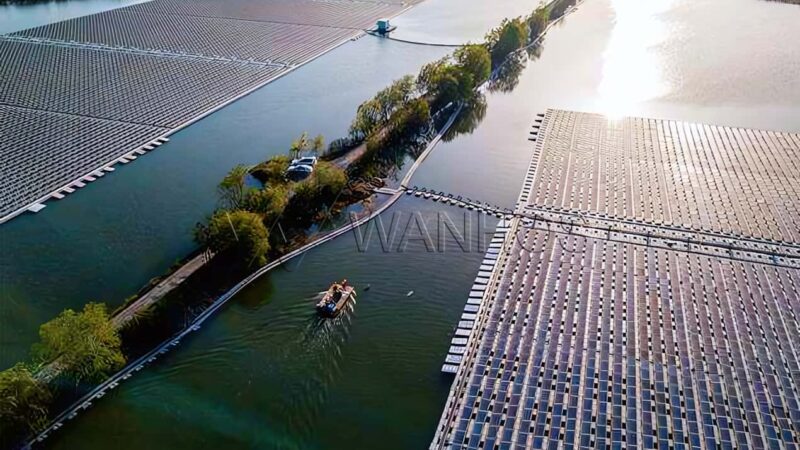
Floating solar power systems are the fundamental form of water-based PV projects. Key components include solar panels, combiner boxes, inverters, transformers, cabling, and solar floating mounting system made of high-density polyethylene (HDPE) floats. These floating structures support the PV modules on the water’s surface.
This type of system is especially suitable for deep-water areas (approximately 3–10 meters). While still largely in the demonstration phase, floating solar represents a promising direction for future expansion as technology continues to mature. Companies specializing as a solar PV floating rack supplier are innovating to improve durability and environmental adaptability.
Applications of Floating Solar
Repurposed Mining Subsidence Areas
Extensive coal mining has led to land subsidence and ecological disruption. Many former mining areas are now perpetually flooded. Floating solar installations provide a sustainable solution by enabling energy generation while supporting ecological remediation—turning environmental challenges into economic opportunities.
Aquavoltaics: Integrating Solar with Fisheries
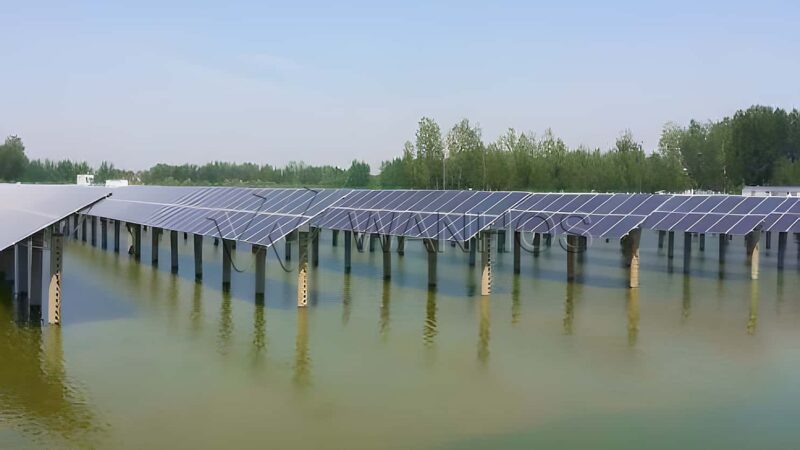
In shallow water zones (under 3 meters), solar arrays can be installed using fixed pile-mounted structures or, in some cases, tracking systems. This approach allows for the dual use of water bodies—solar energy production and aquaculture—creating synergistic “aquavoltaic” systems that boost overall productivity and sustainability.
Benefits of Floating Solar Power Stations
- No Land Occupation: Ideal in regions with scarce or expensive land.
- Higher Energy Yield: Water cooling helps maintain optimal panel temperatures, increasing efficiency.
- Water Conservation: Red evaporation and inhibits algae blooms.
- Economic Advantage: Lower land rental costs compared to terrestrial solar farms.
- Ecological Enhancement: Improves water quality and supports multi-purpose water use.
As technology advances, floating solar is expected to play a growing role in the global renewable energy landscape. More developers and EPC contractors are turning to specialized floating solar mounting company partners for integrated solutions that combine innovative engineering with environmental stewardship.
The Future of Floating Solar
Floating solar power systems not only overcome land constraints but also open new applications for PV technology—particularly in regions with abundant water resources. With ongoing improvements in design and reliability, floating solar is set to become a mainstream solution for sustainable energy worldwide.