How to choose the solar mounting system for mountainous terrain?
Solar power generation is one of the ways to utilize new energy in today’s world. A large proportion of the areas with sufficient sunlight are mountainous areas. In addition, land policies have become increasingly stringent in recent years. And mountain photovoltaic power stations have become a new direction for photovoltaic power station construction. So how to choose solar mounting system and build the photovoltaic power station bracket for mountainous terrain?
As the site of a photovoltaic power station project, the mountain has the advantages of rich light resources, low land rental costs. And it is also with convenient management, little disturbance to residents’ lives, and high land utilization rate. At the same time, mountainous areas are far away from densely populated urban areas and traffic arteries. This also poses many difficulties to the overall construction deployment during the construction period. The plants and forests often cover the mountain surface, the surface is undulating. Meanwhile the terrain height difference is large, and mountain winds are easily formed. The design values of bearing capacity and pull-out resistance should be higher than those in general areas. It is dangerous to construct on the sloped mountain terrain and roads. We also require personnel, equipment, and large machinery to enter the site for large-scale site leveling. Especially when constructing in mountainous areas with slopes. The danger is very high; the convergence of mountain water in the rainy season is prone to soil collapse and landslides. And it also corresponding preventive measures need to be considered; the rock mountain structure is compact and hard. This makes construction difficult and costly.
Due to the complexity of geological conditions, the construction of photovoltaic power stations in mountainous areas focuses on the construction of basic engineering.

Design features
(1) Geological disaster prevention design: The geological conditions in mountainous areas are complex and changeable. And it is tend to occur the geological disasters such as mountain torrents, landslides, soil collapse or mudslides. Therefore, we should take strict geological disaster prevention measures when designing photovoltaic power stations, and prepare slope support and drainage facilities well.
(2) Structural stability design: The foundation anti-pullout meets the requirements and ensures the stability of the soil around the foundation.
Construction characteristics
(1) Different geology, different construction methods. In order to save costs and improve efficiency, we should select spiral steel piles as much as possible under the conditions. Rock strata or other strata that are not suitable for spiral piles should adopt corresponding construction methods. Generally, we can select anchor concrete pile construction technology and submerged cast-in-place pile construction technology.
(2) Different surface forms require different equipment. We can drive in large machinery and equipment for flat terrain. And we can use mechanical construction as much as possible. For terrain with large slopes where large machinery is difficult to enter, we can select small equipment.
(3) During the construction process, we should pay attention to equipment production safety, personnel safety, lightning protection and fire prevention.

Fixed type solar mounting system in mountainous areas
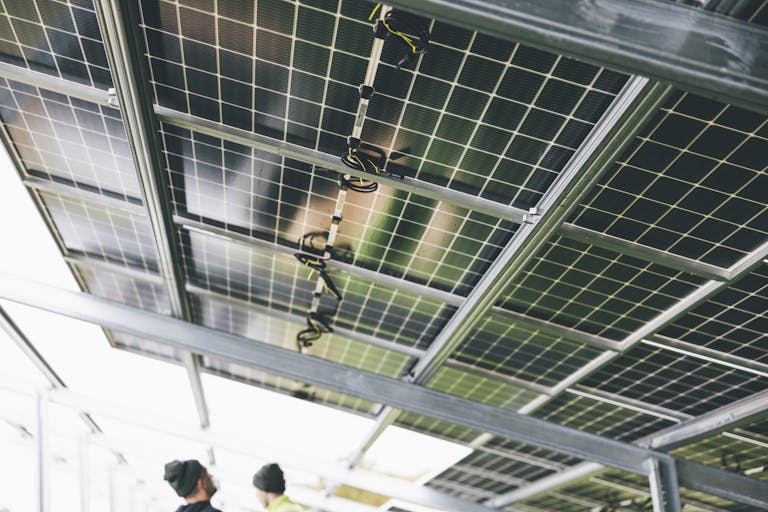
In the design, selection and installation of mountain photovoltaic brackets, we usually use fixed type in mountainous areas. When we arrange the photovoltaic array in a fixed type, we should design the maximum inclination angle in combination with the local multi-year monthly average irradiance, direct component irradiance, scattered component irradiance, wind speed, rain, snow accumulation and other climatic conditions and technical and economic comparison.
The loads in the design of the component support structure mainly include the self-weight of components such as components, wind pressure load, snow load, etc. When calculating the support structure, the largest load is the wind load. This plays a controlling role in the influence of wind load on the photovoltaic support. For example, in Ningxia, my country, most of the damage to the battery array occurs in strong winds. Therefore, we take the quasi-permanent value coefficient of wind load as 1.0 in the load calculation of the photovoltaic support.
The lateral stability of the photovoltaic support array needs to be considered. Adding oblique upward tension bars on the side and back of the support will reduce the vibration of the support array and increase the stability of the support. If we add some windproof structural measures, such as windbreak walls, to the windproof surface of the support array, there will be a great reduction on wind load coefficient of the photovoltaic array, thereby reducing the influence of wind load on the component support.
Wind load information acquisition.
We can obtain the basic wind pressure querying the appendix of the “Code for Loads on Building Structures” GB5009-2012 generally. When the project site is not within the query range, we can obtain it by difference calculation of the wind load value of nearby locations, or calculate it by the Bernoulli equation through the local annual maximum wind speed data. Basic wind pressure w0=1/2 ρv2*S, where ρ is air density, v is wind speed, and S is windward area.
So here are the answers about how to choose the solar mounting system for mountainous terrain above all. We should combine with the actual conditions of the construction site for the design and construction of mountain power stations, and follow the principles of reducing investment, improving system efficiency, and ensuring system operation safety. The support and foundation must be able to adapt to changes in complex terrain, and should have a certain degree of adjustment, so that the array and the terrain have a high degree of matching as much as possible, and its strength must meet relevant technical specifications and standards.
If you are interested in knowing more contents and details, feel free to contact us and share insights.