Important Points For Installing Industrial And Commercial PV Power Stations On Flat Roofs
We tipically install the rooftop solar power stations on unused rooftops, typically residential or commercial. By connecting to the public grid and supplying electricity to the grid, they earn electricity fees and special subsidies to achieve economic benefits. Home solar power stations can operate in two modes, either “self-generated for own use, with surplus electricity going online” or “fully connected to the grid,” depending on the owner’s preferences. Today, we will focus on several important points for installing industrial and commercial PV power stations on flat roofs

Several Key Points Regarding Installing Industrial and Commercial Solar Power Stations on Flat Roofs
1. Which Installation Method to Use
The methods for installing PV modules vary depending on the roof type. Common installation methods include attached, ballasted, and pile-based, as shown in the figure below:
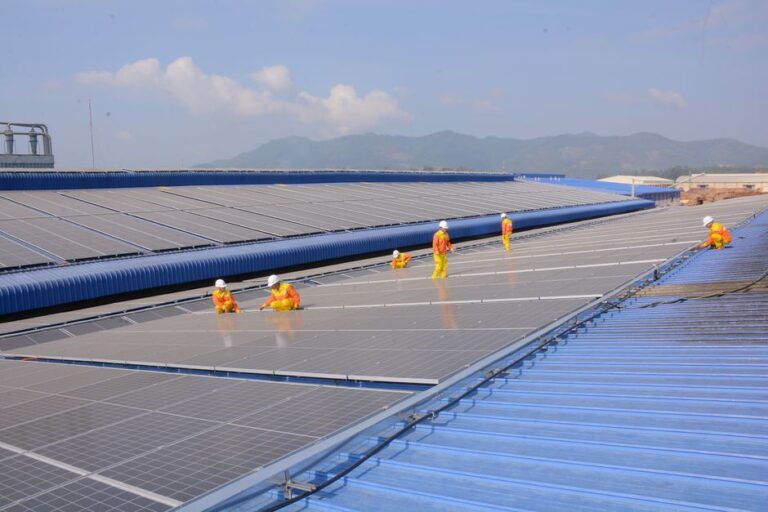
If we cover the roof with color steel tiles, generally consider the attached method, where we lay the module directly flat on the tiles. This is especially true since color steel tile roofs generally lack parapets (a construction engineering term). This makes a flat installation the most effective and safest way to protect against wind. Furthermore, color steel tile roofs have a certain inclination angle. While this angle may not be optimal for solar power generation, we should also consider the cost of retrofitting with a larger angle.
For concrete roofs, which are typically flat, common installation methods include ballasted and concrete pile foundations, as shown in the image above.
Many times, building owners do not permit drilling in flat concrete roofs. It either due to concerns about the strength of the old structure or because they do not want to alter the roof’s waterproofing. This is why we prefer ballasted or concrete foundation installation methods. Since ballasted installations lack an anchoring connection to the roof, we can consider windproofing on the sides, especially for concrete roofs without parapets.
The primary purpose of a concrete foundation is to ensure that the PV mounting system remains intact even during stormy seasons. It ensures a good installation without causing roof leaks, improves the efficiency of the solar panels, and reduces the amount of sunlight blocked by the parapet.
2. Flat Roofs Don’t Mean Flat Installation
We recommend flat-roof installation of PV panels, but there are many factors to consider. We should avoid flat installation, including:
- Flat-roof installations are prone to dust accumulation. This can result in a 10% or even 30% loss in energy production.
- Cleaning is more difficult, and accumulated water is difficult to drain.
- Compared to tilted installations, energy production will be reduced.
- The payback period will be longer.
- Natural rainfall may not be able to remove accumulated dust.
The power generation of tilted and flat-roof PV arrays can differ significantly. A simulation of an 11.2kWp solar system with tilt angles of 10, 5, and 0 degrees showed that at a 0-degree tilt angle. The 11.2kWp system generates approximately 13,480.3kWh annually, while at a 5-degree tilt angle, the system generates 14,066.9kWh annually. In fact, at a 10-degree tilt angle, the system generates 14,520kWh annually.
The results show that for every 5-degree increase in pitch, the system’s annual power generation increases by 500 kWh. After 15 degrees, the increase decreases significantly, and even further after exceeding the optimal pitch angle. Furthermore, the above simulation does not account for power generation losses caused by dust accumulation during low-angle installation.
If you are not willing to use the optimal installation angle, we recommende to install at a higher angle if possible. If a flat roof is necessary, it is recommended to design the angle between 5-10 degrees. For flat roofs, an angle of 5-10 degrees is sufficiently flat, while for color-coated steel tile roofs, an angle of at least 3 degrees is generally allowed. Compared to the additional cost of increasing the pitch, it is better to follow the natural slope.
3. Wind Speed Must Be Considered For Flat Roof Installation
During the design phase of a solar energy system, it is important to consider the maximum possible wind speed in the area, especially in areas with wind speeds exceeding 180 kilometers per hour. The lifespan of a photovoltaic system is 25 years, but we should also consider the possibility of a 50-year natural disaster.
A typical flat-roof solar power system can withstand winds of 160 km/h (a Category 13 typhoon). However, without a parapet to block the wind and proper wind protection between the arrays, the instantaneous wind speeds caused by airflow in certain areas can far exceed the actual wind speed. In this case, professional advice is essential for selecting the support structure, designing the structure, and designing the ballast or concrete foundation strength. Even the flat layout of the color-coated steel photovoltaic support requires scientific analysis.
The above is an introduction to installing industrial and commercial power stations on flat roofs. Generally speaking, rising electricity prices make installing photovoltaic power stations a key option for industrial and commercial applications. Higher electricity prices mean higher costs for manufacturing plants, which can gradually lead to reduced profits and increased expenses. Installing photovoltaic power stations on factory roofs significantly reduces electricity costs and improves business profitability.
Above all are the important points for installing industrial and commercial PV power stations on flat roofs. If you are interested in knowing more or sharing insights with us, please feel free to contact.