
What Is Galvanised Steel? The Backbone of Durable Solar Mounting Systems
When building a solar power plant designed to operate for 25 years or more, every component matters — but none more than the mounting structure. It must withstand high winds, heavy snow, temperature swings, and long-term corrosion. Among all materials used in solar racking, galvanised steel stands out as the industry’s workhorse. But what exactly is galvanised steel, and why do leading solar engineers rely on it for ground-mount projects? Let’s break it down.
What Is Galvanised Steel? A Simple Definition
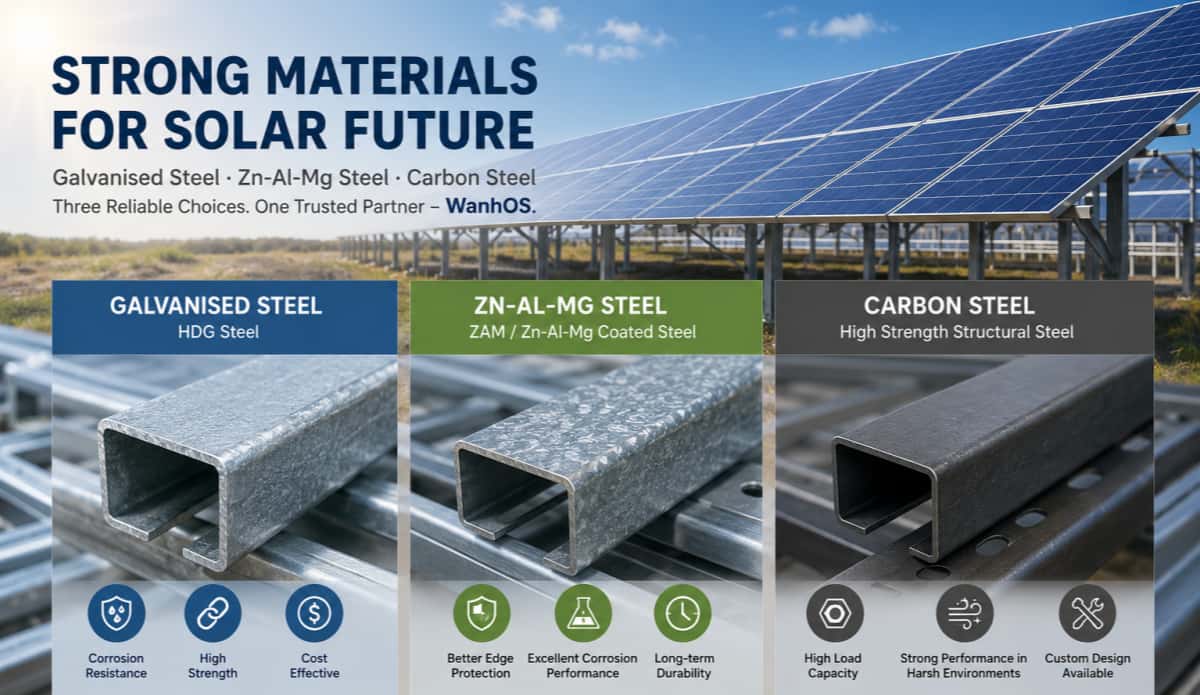
Galvanised steel is ordinary carbon steel that has been coated with a protective layer of zinc to prevent rusting. The most common and reliable method is hot-dip galvanising: steel components are cleaned (acid-washed) and then immersed in a bath of molten zinc at around 450°C. During this process, the zinc reacts with the iron in the steel to form a series of tightly bonded zinc-iron alloy layers. The result is a robust, long-lasting coating that does not just sit on the surface — it becomes part of the steel.
This coating provides two layers of defence:
- Barrier protection – The dense zinc layer seals the steel away from moisture, oxygen, and airborne chemicals.
- Galvanic (sacrificial) protection – Zinc is more electrochemically “active” than iron. Even if the coating is scratched, the exposed zinc corrodes first, protecting the underlying steel until the zinc is consumed. This unique self-healing behaviour is what makes galvanised steel far superior to ordinary painted steel.
Why Is Galvanised Steel the No. 1 Choice for Solar Mounting Systems?
Solar mounting structures are exposed to the elements 24/7. A failure due to rust could collapse entire rows of panels, leading to huge generation losses and safety risks. Galvanised steel solves these challenges with unmatched advantages:
1. Proven 25+ Year Corrosion Resistance
With a typical zinc coating thickness of 55–85µm (as per ISO 1461 or ASTM A123), hot-dip galvanised steel can easily last 25–30 years in most inland environments. In clean rural or desert climates, even longer service lives are common. That aligns perfectly with the expected lifetime of a photovoltaic (PV) power plant.
2. High Mechanical Strength
Steel is inherently stronger than aluminium. Galvanised steel solar racks can handle extreme wind uplift (e.g., 150 km/h+), heavy snow loads (>1.5 kN/m²), and large-span designs without excessive deflection. This is critical for utility-scale ground mounts where structures are taller and spacing is wider.
3. Cost-Effective for Large Projects
Compared to stainless steel or specialised corrosion-resistant alloys, galvanised steel offers the best balance of performance and price. The hot-dip process is fully industrialised, making it affordable even for multi-megawatt solar farms. You get durability without breaking the project budget.
4. Reliable & Well-Understood
Engineers have used hot-dip galvanising for over a century — in power transmission towers, highways, bridges, and now solar. The standards, quality control, and field performance data are extensive, giving project owners peace of mind.
Limitations to Consider (And How Professionals Overcome Them)
While galvanised steel is excellent, it is not perfect for every niche:
- Weight – Steel is heavier than aluminium, so transport and installation require more labour and machinery.
- Aggressive environments – In highly corrosive zones (coastal areas with salt spray, industrial regions with acid rain, or heavy marine atmospheres), the standard galvanised coating may corrode faster. In such cases, a thicker coating (e.g., 85–120µm) or additional sealing is needed.
- Cut-edge and weld protection – Cutting or welding after galvanising exposes bare steel. Professionals repair those areas with zinc-rich paint or redesign components to minimise post-galvanising work.
Reputable manufacturers like Wanhos Solar address these limitations through careful design, coating optimisation, and project-specific advice.
Beyond Galvanised Steel: Aluminium & Carbon Steel Solar Mounts
Every solar project is unique. Some demand lighter weight, others extreme strength, and some require specific corrosion strategies. That is why a truly experienced supplier offers multiple material solutions. Wanhos Solar is one such company — we provide complete engineering and manufacturing for three main material families:
Hot-Dip Galvanised Steel Mounting Systems
Our standard galvanised steel racks use high-strength Q235B or Q355B steel with a uniform 60–85µm zinc coating. Ideal for utility-scale ground mounts, carports, and flat-roof ballasted systems in most climate zones.
Aluminium Solar Racking (6063-T5 / 6005-T6)
Anodised aluminium is naturally corrosion-resistant and about one-third the weight of steel. It is perfect for rooftop projects, balcony solar, and floating PV where weight reduction is critical. Wanhos offers fully pre-assembled aluminium solutions with excellent durability even in coastal areas.
High-Performance Carbon Steel Ground Mounts
For projects that demand the absolute highest strength — such as large-span trackers in heavy snow regions, or structures in challenging terrain — our carbon steel ground mount series (inspired by heavy-duty industrial designs) delivers exceptional load capacity. These mounts are manufactured from premium carbon steel (e.g., Q355B) and then hot-dip galvanised for full corrosion protection. The result: a mounting system that combines raw power with longevity, suitable for the most demanding solar farms. Check out our carbon steel ground mount reference for a similar high-strength architecture.
Why Wanhos Solar? – Engineering Quality You Can Rely On
Having the right materials is only half the story. What truly matters is how they are designed, tested, and delivered. Wanhos Solar brings decades of structural steel and PV racking experience to every project. Here is what sets us apart:
- One-stop material flexibility – We do not push a single solution. Our team analyses your site conditions (wind speed, snow load, soil type, corrosion level) and recommends the optimal material: galvanised steel, aluminium, or high-strength carbon steel.
- End-to-end engineering – From 3D modelling and finite element analysis (FEA) to foundation design and installation manuals, we provide full technical support.
- Global project track record – Wanhos has supplied mounting systems to solar farms in Asia, Europe, the Middle East, and the Americas. We understand international standards (ISO, ASTM, JIS, AS/NZS).
- Quality control – Every batch of galvanised or carbon steel components is inspected for coating thickness, adhesion, and structural integrity before shipping.
- On-time delivery & cost transparency – Our in-house manufacturing and strict supply chain management ensure competitive pricing without compromising on quality.
Final Verdict: Galvanised Steel Remains King, but Choice Matters
What is galvanised steel? It is the proven, cost-effective, and reliable foundation for most solar mounting systems. For the vast majority of ground-mount PV projects, hot-dip galvanised steel offers the perfect balance of longevity, strength, and economy. However, no single material fits all. Rooftop constraints, aggressive coastal environments, or extreme load conditions may call for aluminium or high-strength carbon steel alternatives.
That is where Wanhos Solar excels — we deliver all three options under one roof. Whether you need standard galvanised steel racks, lightweight aluminium structures, or heavy-duty carbon steel ground mounts, we have the technical expertise and manufacturing capacity to meet your needs. Contact us today for a custom material recommendation and a free quotation for your next solar project.
Optimised for solar professionals, EPCs, and project developers. Wanhos Solar – Engineering the backbone of clean energy.


