PV Panel Mounting Decisions That Extend Commercial System Life Beyond the Module Warranty

When we review commercial EPC tender documents, the first line we check isn’t the module wattage or inverter brand. It’s the PV panel mounting specification — because that’s the component where small assumptions turn into extra steel, field rework, or fastener corrosion that shows up long before the module warranty expires. In multi-megawatt commercial projects, mounting structure choices directly control structural steel tonnage, labor hours, logistics cost, and long-term maintenance call-outs. Get it right, and the array stays rigid and well-grounded through decades of wind, thermal cycling, and rain. Overlook a few site-specific details, and the cheapest bid often becomes the most expensive by year five. This article walks through the selection factors that experienced project engineers and procurement teams compare before locking in a PV panel mounting system for commercial rooftops, carports, and ground arrays.
The Real Difference Between Aluminum and Steel Mounting Structures in Commercial Arrays
Most commercial RFQs still pitch aluminum against hot-dip galvanized steel purely on raw material cost. The more useful comparison includes installation labor, corrosion reserve, and structural weight — especially when roof load capacity or ground foundation concrete volumes are on the line.
Aluminum profiles, typically AL6005-T5 alloy, weigh roughly one-third of an equivalent steel section. On large flat roofs with limited structural reserve, that weight saving often allows more modules without expensive roof reinforcement. The anodized surface (commonly AA15 or AA20 grade) provides natural corrosion resistance without the risk of zinc depletion that hot-dip galvanized coatings face over decades. In coastal or high-humidity industrial zones, aluminum rails paired with SUS304 stainless steel fasteners essentially remove the galvanic corrosion risk that occurs when standard zinc-plated bolts meet steel in salty air.
Hot-dip galvanized steel (Q235B or Q355B grade) still dominates many ground-mount projects where self-weight matters less and where the structure must absorb larger bending moments from wide row spacing. Steel purlins and columns can be fabricated to higher section moduli without the buckling limits that sometimes constrain long-span aluminum beams. But the galvanizing thickness (typically minimum 65 µm for C3 environments, >85 µm for C4) must be specified in the procurement document, not assumed. We have seen commercial ground-mount failures where a 45 µm coating, fine for inland dry climates, was delivered to a site only two kilometres from the sea. The result was red rust at bolt holes within three monsoon seasons.
The table below summarises the practical trade-offs that most commercial buyers weigh.
| Material & Grade | Weight per Meter (typical rail) | Corrosion Resistance | Typical Application | Installation Speed Factor | Relative Cost Driver |
|---|---|---|---|---|---|
| Aluminum AL6005-T5 | Low (~1/3 of steel) | Excellent in C1–C4 with proper anodizing | Commercial flat roofs, carports, coastal ground mounts | Faster handling, less lifting equipment | Higher material unit price, lower roof strengthening cost |
| Hot-Dip Galvanized Steel Q235/Q355 | Higher | Good if coating ≥65 µm; risk at cut edges and threads | Large ground-mount ramming structures, wide spans | Heavier handling, more crane time | Lower raw material cost, higher foundation and labor cost |
| SUS304 Stainless Fasteners | — | Very high; no coating depletion | All coastal or aggressive environment bolted connections | Same tooling, fewer corrosion call-backs | Slightly higher fastener cost; offsets long-term maintenance |
Roof or Ground: The Foundation Choice That Sets the Budget and Logistics Plan
The PV panel mounting system rarely exists in isolation. The interface with the building or the soil is where project cost uncertainty lives. For commercial flat roofs, ballasted systems avoid penetrations and keep the roof warranty intact, but the added ballast blocks must not exceed the roof’s residual load capacity — a point that the structural engineer must confirm against the original building design. We often see EPCs push for lightweight aluminum east-west ballasted systems with integrated wind deflectors that reduce ballast weight by up to 30% compared with fixed-tilt south-facing layouts, but only when site wind tunnel testing or CFD analysis supports the lower ballast figure.
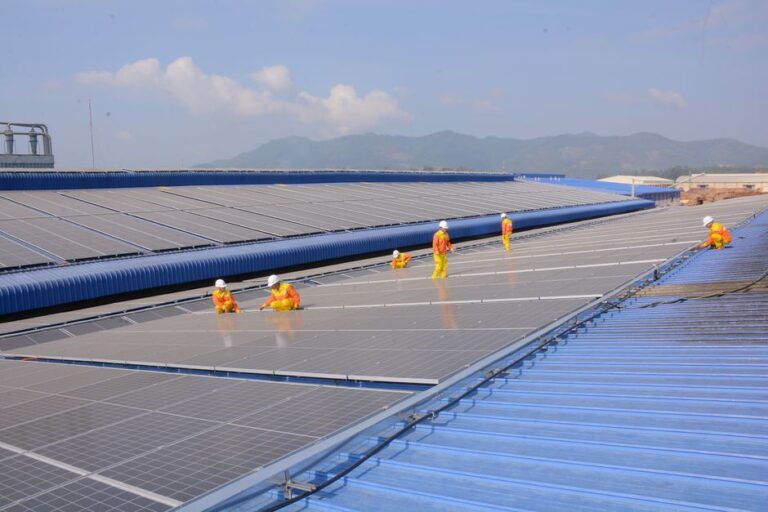
On trapezoidal sheet metal roofs common in warehouses, PV panel mounting relies on rail-based or rail-less clamps fixed to the roof ribs. Rail-less systems reduce aluminium channel material and can speed up installation by 15–20% when modules align with rib spacing, but they demand tight rib profile compatibility and careful clamp positioning near the module frame’s allowed clamping zones. A mismatch in clamp height versus rib height leads to module glass stress that only shows up as microcracks months later.
For ground-mounted commercial arrays, the choice between driven piles, helical screw piles, and concrete foundations is decided more by geotechnical data than by preference. Sandy, stone-free soils let helical screw piles and C-section steel posts achieve rapid installation with torque-monitored driving that confirms bearing capacity on the spot. In clay or rocky ground, pre-drilled concrete piers or micro-piles become unavoidable, and the mounting structure must be designed with base plate adjustability to compensate for post-driving tolerances. This is where adjustable column base connections, not fixed welded base plates, prevent misalignment headaches during module rail assembly.
Rail-Based vs. Rail-Less PV Panel Mounting: Labor Hours, Module Compatibility, and Wind Uplift
The rail-based versus rail-less debate in commercial projects is rarely about “better” — it’s about module dimensions, workforce skill, and local wind loading. Rail-based systems, with two continuous aluminium or steel rails running under each module row, provide a forgiving platform for installers who need to adjust module position, manage row spacing, and integrate grounding lugs without worrying about exact rib alignment. They also distribute wind uplift loads more evenly into multiple roof attachment points. For 72-cell large-format modules with long frames, rails prevent mid-span module sag that can occur with point-mounted rail-less clamps on certain frame thicknesses.
Rail-less mounts eliminate the rails entirely. Clamps attach directly to trapezoidal sheet ribs or standing seam profiles, and modules bolt onto those clamps in landscape orientation. The material bill of materials drops, and the installation sequence often removes an entire step of rail splicing. But the trade-off shows up in wind uplift. Rail-less connections concentrate load at individual seam clamps, so the roof fixing density must be higher than a rail-based layout to handle the same design wind pressure. Before selecting rail-less PV panel mounting for a commercial metal roof in a cyclone-prone region, the clamp pull-out values and seam strength must be verified — not assumed from datasheets meant for low-wind zones.
Why Site-Specific Wind and Snow Load Verification Protects More Than Just the Mounting Structure
Commercial projects in different climates still sometimes rely on generic “wind speed 45 m/s” assumptions. The mounting structure is the most exposed component in the load path, and over-specifying adds steel cost, while under-specifying risks catastrophic module loss. Local codes (AS/NZS 1170, Eurocode 1, ASCE 7, etc.) all require wind pressure calculated at specific terrain categories, building height, and roof zones. Edge zones on a 15-metre high warehouse wall experience pressure coefficients two to three times higher than the middle of the roof. A single rail bolt pattern suitable for the interior zone may not hold the perimeter row unless additional roof anchors are added.
Snow load in high-altitude regions adds another layer. Beyond the uniform snow depth, drifted snow at roof obstructions and the cumulative weight must be checked against the aluminium rail’s moment capacity over the defined span. In ground-mounted arrays, uneven snow settlement can impose differential loads across tilted modules that slowly twist clamps if the rail joint is too rigid. The pv panel mounting design should allow for minor thermal and mechanical slip at rail splices instead of fully locked rigid connections that concentrate stress at a single bolt. This kind of field observation is rarely in a datasheet; it comes from reviewing arrays after four or five winter seasons.
Corrosion, Fasteners, and the Small Details That Keep a 25-Year Mounting Warranty Meaningful
Module manufacturers love to talk about 25-year linear power output warranties. Mounting structure warranties often match that timeline, but what actually ages first are the fasteners, grounding clips, and hidden steel edges. In commercial PV panel mounting, the material pairing matters more than the primary structure alloy.
Galvanic corrosion appears when dissimilar metals are bolted together in the presence of moisture — a perfect description of a rooftop array with aluminium module frames, steel brackets, and zinc-plated bolts exposed to morning dew. The solution is not exotic; it’s disciplined use of stainless steel grade hardware. SUS304 bolts, washers, and nuts should be specified as standard for any outdoor bolted connection, especially at the rail-to-clamp and clamp-to-module interfaces. The small extra cost vanishes across a decade of avoiding rust-stained modules and seized bolts that turn a simple module replacement into an angle-grinder job.
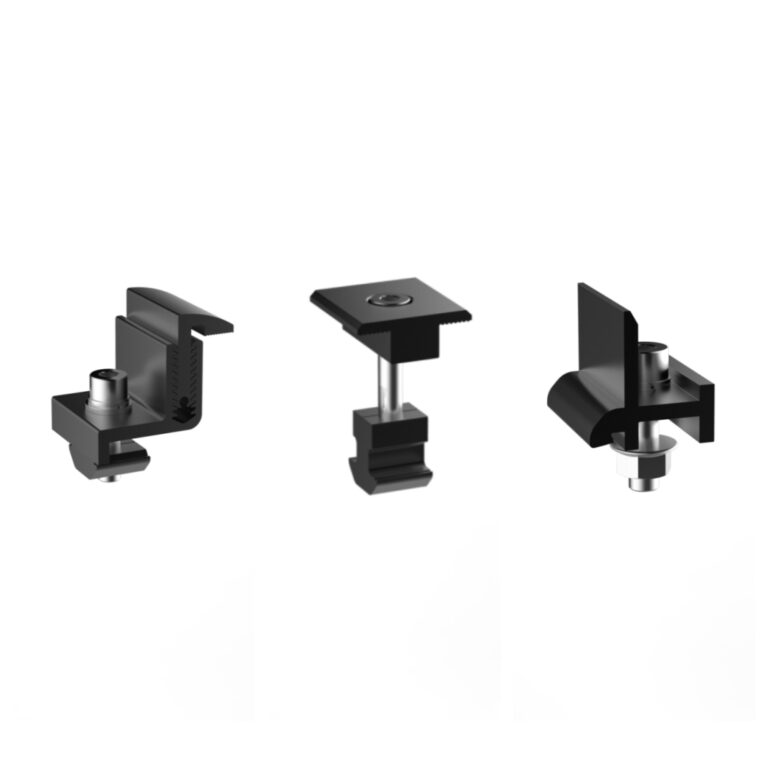
Beyond the bolt grade, pre-assembled clamps with captive nuts and integrated spring washers reduce installer error. When torque must be controlled to avoid over-compressing the module frame (most manufacturers allow clamp torque of 14–18 N·m depending on frame design), a calibrated torque wrench is essential. Pre-assembled units that ship with factory-set gap dimensions remove the guesswork on site.
Another overlooked detail is the drainage path. On low-slope commercial roofs, rail-based systems should allow water to flow under the rails without ponding against the module backsheet. Small drainage gaps between rail and roof surface, or rail profiles with open-bottom channels, prevent long-term standing water that accelerates aluminium pitting even on anodized surfaces.
Engineering Tip: Clamp Positioning Near Module Frame Zones
Every module datasheet specifies “clamping zones” — marked regions along the long or short frame where mechanical load is rated. Installers shifted the clamp 30 mm outside that zone on a coastal warehouse project we reviewed, and within a year the additional bending moment on the frame corner caused glass breakage during a moderate storm. The mounting rail layout must be designed so that clamp positions fall within the allowed zones for the specific module orientation (portrait or landscape). When module types change mid-project, the rail slot dimensions and clamp type may need re-checking.
Supplier Capabilities That Matter More Than the Lowest Bid
Commercial procurement teams naturally compare per-watt or per-tonne mounting system prices. What separates a reliable long-term supplier from a transactional vendor shows up in three areas: engineering support, pre-assembly depth, and documentation.
A mounting system supplier that provides project-specific load calculations, roof attachment pull-out test reports, and wind load analysis based on local standards shortens the approval cycle with the client’s structural engineer. Instead of the EPC having to model every rail span, the supplier delivers stamped layout drawings with reaction loads already calculated for each roof fixing point. For ground-mounted arrays, the foundation design output — pile embedment depth, spacing, and steel section — should be backed by geotechnical correlation with the site’s soil report. This engineering input often shaves 2–3 weeks off the design review phase before steel even reaches the site.
Pre-assembly is another cost lever. Mounting kits that arrive on pallets with rails pre-cut to row length, clamps pre-assembled with fasteners, and clearly labelled zone-by-zone packing lists reduce on-site sorting time and eliminate the discovery that half the M10 bolts shipped are the wrong length. In commercial projects where installation crews are paid by the day, this logistics detail translates directly into lower controllable cost per megawatt.
Frequently Asked Questions from Commercial Project Buyers
How do I choose between aluminum and galvanized steel for a ground-mount array near the coast?
Within 500 metres of saltwater, aluminum (AL6005-T5 with AA15 anodizing minimum) paired with SUS304 stainless fasteners is the lower-risk choice. Galvanized steel can work if the coating thickness exceeds 85 µm and edge protection is applied to all cut surfaces, but the maintenance burden for recoating or replacing corroded bolts over 25 years will likely exceed the upfront steel cost saving.
What wind load rating should I specify for commercial roof mounting systems?
Do not specify a single wind speed. Provide the design wind pressure (in kPa or Pa) derived from the local building code for the specific roof zone, building height, and terrain category. A mounting system that handles 2.4 kPa in zone 1 may fail at 4.8 kPa in the corner zone. Ask the mounting supplier to confirm the allowable load per roof attachment for each zone based on test data or calculation.
Can I use the same mounting system for both framed and frameless modules?
Not without design changes. Frameless (glass-glass) modules typically require wider clamp contact area and different gasket material to avoid point stress. Some rail profiles and clamps are dual-rated, but the maximum clamping force and allowed clamp positions must be verified with the module manufacturer’s latest installation manual.
What is the typical lead time for a custom pre-assembled commercial mounting kit?
For projects above 500 kW, once the layout and structural design are finalised, pre-cut rails, pre-assembled clamps, and packed kits can be shipped in 4–6 weeks depending on the factory location and container availability. The design and load-calculation phase beforehand takes 1–2 weeks if all site information is provided upfront.
How can we reduce on-site installation hours for a multi-megawatt ground-mount project?
Three fast ways: use ground screw foundations with torque-monitored driving to eliminate concrete curing time; specify pre-assembled clamp sets that clip onto rails without loose bolts; and adopt rail splice designs that allow thermal expansion movement without requiring perfect on-site cutting. We’ve seen crews cut over an hour per row just by eliminating the need to cut and deburr rail ends in the field.
Before You Send a Quotation Request
The commercial PV panel mounting specification is never a one-size-fits-all line item. Every project brings a unique combination of roof type, wind zone, soil condition, module size, and installation window. The patterns we see in well-planned projects are consistent: they match material choice to the real corrosion environment, verify loads against the exact roof zone, choose the rail or rail-less approach based on labor skill and wind uplift data, and insist on pre-assembled hardware that removes variability from the installation day.
If you’re currently comparing mounting system options for a commercial project, Wanhos provides aluminium-based roof and ground mounting solutions with SUS304 stainless steel fasteners, pre-assembled clamp interfaces, and project-specific load calculation support. We work with EPCs and developers to dimension the structure based on your site’s actual wind, snow, and installation conditions — not generic defaults. Send us your site location, roof type or soil report, module dimensions, desired tilt angle, and design wind speed. Our engineering team will review the load case, recommend a mounting structure that fits your project’s