Solar Panel Carport Design Factors That Change Steel Use, Parking Layout, and Payback

If you are evaluating a solar panel carport for a commercial parking lot or EV charging station, the design factors that most influence steel tonnage, long-term maintenance, and true payback are parking bay spacing, drainage slope, and load path verification—not just module tilt angle. Many EPC teams and developers first fix the module angle, then realize later that column spacing or drainage rework has already added extra steel weight or created pooling problems that eat into the project margin. This article walks through the structural and procurement decisions that actually change cost and reliability, so you can specify a solar carport that fits the site and the budget without over-engineering or introducing hidden failure points.
Parking Layout Dictates Steel Tonnage More Than Module Tilt
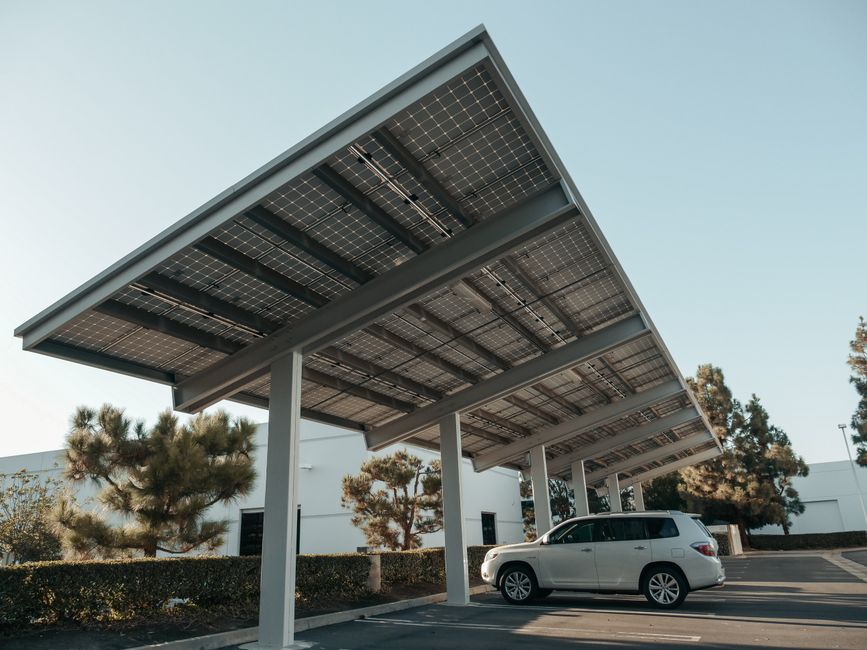
Solar carport columns cannot land in the middle of a parking space. Vehicle maneuvering clearance and local parking standards fix the column grid before the structure is even designed. For a standard 2.5 m × 5 m parking bay, columns typically fall on the bay’s longitudinal axis near the front or rear bumper zone, which means the clear span between columns is driven by the number of bays per structural bay. A single-row carport covering four bays often has a column spacing around 10 m, while a double-row layout can push that to 12 m or more when the aisle side columns are staggered. Every extra meter of span increases the required beam section height and wall thickness—sometimes by 15–20% in steel weight compared to a shorter span with the same tilt angle.
Common mistake: assuming a 5° or 10° module tilt is the main cost driver. In reality, a poorly planned column grid that forces a 12 m span where 9 m would have worked adds more steel per kW than a tilt angle change of a few degrees. Before finalizing module orientation, verify the minimum bay dimensions, aisle width, and local fire access requirements. This alone often saves more material cost than optimizing purlin spacing or rail profile.
Drainage Design That Prevents Water Damage to Vehicles and Structure
Water pooling on a solar carport is not just a nuisance—it accelerates corrosion at bolted joints, increases dead load during snow events, and drips concentrated runoff onto vehicles below. The structural frame itself must provide a controlled drainage path. Most well-designed carports use a built-in gutter integrated with the main beam or a dedicated channel between module rows, sloped at least 1–2% toward downpipes. Without it, water sheets off the module lower edge randomly, which in freezing climates creates ice build-up on walking areas and vehicle roofs.
For projects in regions with heavy snowfall, the drainage design must also account for snow melt refreeze. If the gutter freezes solid while the module surface thaws during the day, meltwater can back up under the module frame, creating ice dams that load the mounting clamps in ways the structural model didn’t anticipate. Galvanized steel gutters with a polyurethane coating or aluminum gutters with stainless steel fasteners hold up better in these conditions than plain galvanized sections, but the slope, downpipe size, and thermal expansion gaps must still be verified against local weather data, not just a generic 1% rule.
Load Paths: Wind Uplift, Snow, and Seismic Considerations
A solar carport is an open-sided canopy structure. Wind loads act on both the upper module surface and the underside, creating net uplift pressures that can be higher than those on a ground-mount array at similar height. The structural verification must follow EN 1991-1-4, ASCE 7, or AS/NZS 1170, but the real-world risk is often at the connection between the beam and the column base plate. If the base plate anchor bolts are not cast with sufficient embedment depth or edge distance in the concrete pier, wind uplift can crack the foundation over multiple storm cycles, especially in soft soil conditions.
Snow load is similarly uneven. Snow drifts can accumulate on the leeward side of a carport roof, creating a non-uniform load pattern that twists the main beams if purlin connections are not rigid enough. For sites above 1000 m elevation or in heavy snow zones, request a drift load check from the structural engineer and verify that the beam-to-column connection can handle the resulting torsional moment without relying on friction alone. Using a bolted end plate connection with tension-controlled torque on the bolts provides a verifiable load path, unlike site-welded joints whose quality depends heavily on weather and welder skill.
Engineering Tip: Bolt Torque and Vibration Loosening
All structural bolted connections on a solar carport—especially base plate bolts, beam splices, and purlin-to-beam brackets—should be tightened to a specified torque based on bolt grade and lubrication condition, and then marked for visual inspection. In traffic areas where heavy vehicles cause ground vibration, consider using Nord-Lock washers or similar wedge-locking solutions rather than split lock washers, which lose effectiveness under dynamic load. Loose bolts are one of the most common findings during post-storm inspections on carports installed without torque control procedures.
Module Compatibility and Frame Clamping Zones
Solar carport structures often use larger-format modules (182 mm or 210 mm cells) that have specific clamping zone requirements defined by the module manufacturer. The mounting rail or purlin spacing must align with these zones, usually within a narrow window near the module frame’s long-side edge. If the carport design places a beam directly under the module center for structural efficiency, but the module’s allowable clamp zones are only at the quarter points, the installer faces a conflict: either add extra cross rails (more steel, more labor) or risk invalidating the module warranty by clamping outside the approved area.
Before finalizing the carport structural layout, cross-check the module manufacturer’s installation manual clamping zone dimensions with the proposed purlin positions. This is a simple pre-order check that prevents costly field modifications. Also, leave enough thermal expansion gap between module frames—typically 5–10 mm for aluminum frames on steel purlins, depending on temperature range. A tightly butted array can buckle in summer or stress mid-clamps into a fatigue failure pattern over years.
Pre-Assembled vs. Site-Welded Steel: Which Saves Real Time and Cost?
Many solar carport projects still default to a welded steel frame fabricated on site, but pre-galvanized bolt-together systems have matured to offer faster installation and more consistent corrosion protection. The table below compares the two approaches for typical commercial carport projects.
| Factor | Pre-Galvanized Bolt-Together | Site-Welded + Hot-Dip Galvanizing |
|---|---|---|
| Corrosion Protection | Zinc coating applied to sheet before forming; cut edges cold-galvanized with zinc-rich spray. Consistent coverage. | Post-weld hot-dip galvanizing provides thick coating, but welds are often ground before galvanizing; quality depends on bath conditions and handling. |
| Installation Labor | Bolt assembly requires no hot work permit; faster erection, especially on active parking lots. Can be installed with small teams. | Welding needs qualified welders, weather protection, and post-weld coating repair. Longer on-site time. |
| Quality Control | Factory-drilled holes and jig-assembled components reduce fit-up errors. Bolt torque can be verified with a wrench. | Weld quality varies with welder skill; difficult to inspect all joints after painting or galvanizing without NDT. |
| Cost Sensitivity | Higher material unit cost but lower total installation hours; favored when labor rates are high or site access is limited. | Lower raw steel cost but higher site labor and logistics cost; may be viable in regions with low labor cost and easy site access. |
For projects where the carport must be disassembled and relocated later—such as temporary parking structures or leased sites—bolt-together systems have a clear advantage. For permanent installations in coastal environments, both options require careful attention to galvanic corrosion between dissimilar metals, but bolt-together designs allow individual component replacement without cutting and re-welding.
Key Takeaways
- Parking geometry determines column spacing, which drives beam size and steel weight—fix the bay layout before locking the tilt angle.
- Integrated drainage and verified load paths (uplift, drift snow) prevent long-term corrosion and foundation cracking that are expensive to retrofit.
- Pre-assembled, bolt-together steel structures often reduce on-site welding risks and installation time, especially on active commercial lots.
FAQ: Solar Panel Carport Design and Procurement
- Is a solar carport structure always made of steel, or can aluminum be used?
- Aluminum can be used for solar carports, but only when the clear span is relatively short (generally under 6 m between columns) and the site is not in a heavy snow or high-wind region. For large commercial spans of 8–12 m, steel remains the practical choice due to higher stiffness and lower deflection under load. Aluminum’s lower modulus of elasticity means deeper sections or more intermediate supports are needed to control deflection, which often negates its corrosion advantage for large carports.
- How do I prepare a quotation request for a solar carport structure?
- Include the parking layout drawing (bay size, number of bays, single or double row), local wind and snow load design values, module datasheet with clamping zone dimensions, desired tilt angle or range, whether a gutter system is needed, and any site-specific constraints like vehicle height clearance or fire lane access. Providing these details at the start lets the mounting supplier size beams, columns, and foundations accurately without multiple redesign rounds.
- What foundation type is most common for solar carports?
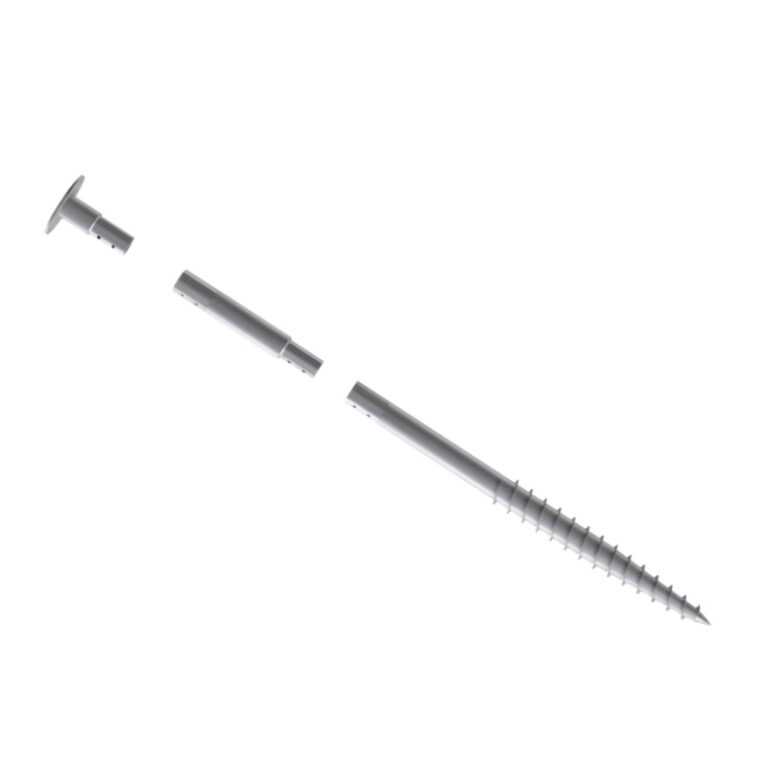
- Cast-in-place concrete piers with embedded anchor bolts are typical for permanent installations. Ground screw piles can work in some soil conditions but transferring the moment from the column base into a screw pile requires careful geotechnical verification; not all soil profiles support the lateral loads from wind on a raised canopy. For temporary carports, ballasted concrete blocks are sometimes used but demand a larger footprint and heavier transport cost.
- Do I need to earth and bond a solar carport structure?
- Yes. The steel or aluminum frame must be bonded to the facility’s grounding system. For bolt-together structures, continuity across bolted sections should be verified—paint or oxidation layers can break the ground path. Use serrated washers or dedicated bonding jumpers at connections where continuity cannot be guaranteed by bolt contact alone. This is a standard requirement in PV system earthing standards.
- How do I avoid corrosion at bolted connections on a steel carport near the coast?
- Specify SUS304 or SUS316 stainless steel fasteners with isolation washers or bushings if the structural steel is carbon steel. Even hot-dip galvanized steel can suffer accelerated zinc consumption at bolt holes where the coating was damaged during assembly. Applying zinc-rich touch-up spray to holes before bolt installation and using neoprene washers between dissimilar metals reduces corrosion cell formation.
Project Recommendation: Matching the Carport Structure to Site and Budget
A well-designed solar panel carport does more than hold modules above parking spaces. It manages water, resists wind loads without oversized steel, and allows installers to work quickly with minimal rework. Before you send a request for quotation, walk through the layout with the bay spacing, drainage direction, and module clamping zones in hand. These three items fix the steel tonnage, the maintenance exposure, and the module warranty compliance—everything else falls into place afterward.
If your next project requires a bolt-together, pre-galvanized steel carport structure with integrated drainage channels, verified load paths, and clamp positions aligned with today’s large-format modules, reach out to Wanhos with your project drawings, design loads, and module specifications. Our engineering team provides a tailored structure recommendation that accounts for local wind codes and installation access constraints, helping you lock in a reliable carport design without over-buying steel.