Solar Racking Decisions That Change Commercial Project Cost, Labor, and Lifetime Performance

For commercial solar projects, the racking system is not an interchangeable commodity. It directly governs how many modules stay structurally sound for 25 years, how quickly installation teams can move across a roof or ground field, and what ongoing maintenance will cost. A racking choice that looks economical on a line-item quote can introduce wind uplift failures, excessive on-site assembly, or corrosion-induced fastener replacement that destroys project margins. This guide focuses on what EPC contractors, developers, and procurement managers actually need to weigh — from material selection and pre‑assembly to foundation logic and supplier evaluation — so that structural decisions support financial performance, not the other way around.
Why Commercial Solar Racking Demands a Different Engineering Mindset
Residential racking rarely encounters the same structural scale. A 500 kW commercial rooftop or a 5 MW ground mount introduces aerodynamics, thermal expansion, and module layout patterns that small systems can absorb without noticeable risk. Wind loads do not scale linearly across a large array. Edge zones, corner regions, and interior areas all see different pressure coefficients, especially on low-slope commercial roofs where wind funnelling between parapets changes uplift forces dramatically. Racking design must reflect those zones with appropriate rail spans, clamp quantities, and attachment spacing.
Snow load is another variable that multiplies quickly. A ground mount in a 2.5 kPa snow region may look fine with standard rail spacing, but drift accumulation near the array edge or between rows can concentrate loads beyond what a single structural verification point assumes. For commercial projects, always verify load combinations — wind + snow, wind + dead load, wind + maintenance access — per a local engineering code like ASCE 7, Eurocode, AS/NZS 1170, or the applicable national standard. Avoid generic “certified for X wind speed” claims that do not reference exposure category, building height, and array geometry. A racking system that passed a wind tunnel test on a 10° tilt ground mount in one terrain category tells you nothing about a 5° tilt commercial flat roof in another.
Aluminum vs. Steel Racking: Practical Trade-offs for Commercial Projects
Material choice in commercial racking is rarely a simple cost-per-kilogram decision. It affects logistics, corrosion risk, installation speed, and long-term maintenance. Here’s how the two dominant options compare in the field:
| Criteria | Aluminum (AL6005-T5) | Hot-Dip Galvanized Steel (Q235B) |
|---|---|---|
| Weight | ~2.7 g/cm³ | ~7.8 g/cm³ |
| Corrosion resistance | Natural oxide layer; anodizing improves durability | Zinc coating sacrificial; risk at cut edges & scratches |
| Installation speed | Lighter, faster handling; no heavy lifting equipment | Heavier; may slow roof-level movement |
| Typical use in commercial | Roof mounting rails, clamps, purlins | Ground mount columns, foundations, heavy-load beams |
| Galvanic risk | Low when paired with SUS304 fasteners & EPDM pads | Can accelerate aluminum corrosion if direct contact without isolation |
| Lifespan | 25+ years in most environments | 25+ years if coating maintained and drainage good |
In practice, commercial projects often benefit from a hybrid approach. Wanhos commonly supplies AL6005-T5 rails and clamps for roof installations because the lighter weight eases handling on elevated structures and avoids overloading roof decks. For large ground mounts, main columns and cross beams may use hot-dip galvanized steel where the cost difference offsets the extra weight, while aluminum rails still reduce top-side mass and speed up panel clamping. The key is not material purity but making sure all contact points between dissimilar metals are isolated with EPDM gaskets or nylon washers and that stainless steel fasteners — SUS304 at minimum — are used throughout to prevent galvanic corrosion in humid or coastal sites.
Pre-Assembled Components and Their Impact on Commercial Labor Costs
One detail that consistently separates high-performing commercial installations from frustrating, over-budget ones is the level of pre-assembly in the racking package. Traditional racking arrives as loose rails, separate clamps, small bags of hardware, and end caps that must be assembled piece by piece on a roof under time pressure. For a 1 MW commercial flat roof, that might mean tens of thousands of individual fasteners. Every minute spent handling small parts, aligning bolts, and checking torque adds up to days of extra labor and, more importantly, increases the chance of dropped objects, misplaced fasteners, and inconsistent clamping force.
Wanhos designs commercial racking with pre-assembled clamps, integrated earthing pins, and rail connectors that slide into position without removing fasteners from a bag. On a typical commercial rooftop, this approach can reduce on-site installation labor by 10–15% compared to fully loose-component systems, based on field feedback from EPC supervisors. It also standardizes clamp positioning, which improves module edge support consistency. For project developers watching bid competitiveness, shaving even half a day per megawatt from the installation schedule directly improves the bottom line.
Roof Mounting Decisions for Commercial Structures
Commercial buildings rarely have a single uniform roof type. A project may span a standing seam metal roof over a warehouse, a TPO membrane over an office block, and an older trapezoidal sheet area. Racking attachment methods must adapt without creating leak risks, overloading the structure, or voiding roof warranties.
For standing seam metal roofs, non-penetrating clamps that grip the seam profile are the standard choice. The clamp must match the exact seam geometry — double-fold, snap-lock, nail strip — and provide enough holding force for design wind uplift without deforming the seam. On trapezoidal metal roofs, L-feet brackets fastened through the crown with EPDM washers remain common, but fastener pull-out resistance in thin gauge sheets must be checked against pull-out test data or manufacturer tables.
Flat commercial roofs introduce a different challenge: ballasted or mechanically attached systems. Ballasted racking avoids penetrations but demands a dead load check against the roof structure; 15–25 kg/m² is typical, but that number can climb quickly with higher tilt angles or wind zones. Mechanically attached racking fixes to the roof deck but must integrate with the waterproofing system. Specifying a racking supplier who can provide project‑specific wind load calculations and roof attachment layouts — not just a catalog of brackets — avoids the scenario where the mounting system passes a lab test but fails the actual building conditions.
Engineering Tip: Wind Uplift on Low-Slope Commercial Roofs
Uplift forces are not uniform. The perimeter and corner zones of a low-slope roof experience significantly higher negative pressure than the interior. Racking layouts should increase attachment density in those edge zones, and ballasted systems must either add more weight or use aerodynamically designed panel configurations that reduce lift. Wanhos engineering support can help generate zone-based attachment plans when project location and roof geometry are provided early.
Ground Mount Foundations: When Screw Piles Beat Concrete
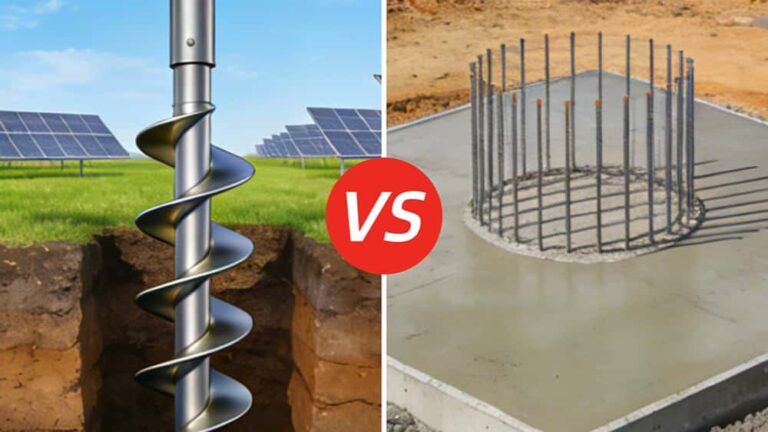
Commercial ground mount projects above 1 MW often default to cast-in-place concrete foundations out of familiarity. But helical screw piles are changing the logic, especially where project timelines are tight or soil conditions suit them. Screw piles install with hydraulic rotary equipment, achieve immediate load capacity, and leave no concrete curing delay. In sandy or clay soils without large boulders, a crew can install several hundred piles per day, whereas concrete foundations may require weeks of excavation, forming, and curing before racking assembly can begin.
The trade-off is that screw piles need a geotechnical report and sometimes pull-out testing to confirm capacity. In rocky ground, refusal can stop installation entirely. For mixed soil profiles, a project may use screw piles where penetration works and concrete micropiles where refusal occurs. Wanhos ground mount systems are compatible with both foundation types because column base plates can adapt to screw pile flanges or standard anchor bolts. When evaluating ground mount racking, ask the supplier for a connection detail that works across foundation scenarios, not a one-size-fits-all base plate that forces the civil contractor into rigid design constraints.
Corrosion Resistance and Long-Term Performance in Harsh Environments
Commercial arrays often sit in environments far more aggressive than residential neighborhoods. Agricultural zones expose racking to ammonia-laden humidity from fertilizers. Coastal salt spray accelerates corrosion within a few kilometres of breaking surf. Industrial areas carry airborne chemicals that degrade protective coatings faster. Choosing the right material and fastener combination upfront determines whether the racking looks intact after 15 years or requires expensive recoat work.
Aluminum 6005-T5 with anodized surface treatment handles mild coastal and industrial exposure well, but in severe marine environments within 500 m of the coastline, many engineers specify higher-grade stainless fasteners (SUS316 instead of SUS304) and extra isolation pads between aluminum and steel components. Galvanized steel that gets scratched during installation loses its zinc protection at that point, so touch-up zinc spray is not optional. Wanhos uses SUS304 fasteners as standard and offers SUS316 for projects with explicit corrosion requirements. All rail splice zones and clamp contact points include EPDM gaskets to break the electrical continuity that drives galvanic corrosion.
What to Inspect After Severe Weather
After extreme wind, hail, or heavy snow, walk a few array sections and check: loose clamp bolts (torque marking helps), deformation of rail ends or mid-span sag, trapped water pooling on horizontal surfaces, and any visible rust spots on galvanized steel. Catching a few loose fasteners early prevents cascading module misalignment and potential microcracking of module glass.
How to Evaluate Suppliers and Avoid Costly Project Delays
A low per-watt racking price means nothing if the supplier cannot deliver structural calculations, customisation support, and reliable logistics. Before selecting a racking partner for a commercial project, check these points:
- Engineering support: Can they provide site-specific load analysis, not just generic datasheets? Do they know the local building code and wind/snow maps?
- Pre‑assembly level: How much on-site assembly is required? Do clamps arrive loose or pre-mounted on rails?
- Product traceability: Can they document material certificates for aluminum 6005-T5 and steel grades? Are fastener batches traceable?
- Lead time reliability: For large orders, what is the real track record? Ask for reference projects of similar scale in your region.
- On-site support: Will they send a supervisor for the first days of installation to catch layout mistakes before they compound?
Wanhos has supported commercial installers across multiple geographies by providing stamped engineering letters for permit submissions, pre‑assembled rail packages, and direct communication with EPC site managers during the critical early installation phase. In commercial solar, a few thousand dollars saved on racking but spent on extra labor, delays, or structural rectifications is never a good trade.
Frequently Asked Questions
What wind load rating should commercial racking have?
There is no single rating. The racking must be checked against the project’s specific wind speed, terrain category, building height, and array geometry. Always request a structural analysis report that references the applicable building code (ASCE 7, Eurocode, etc.) and shows zone-by-zone attachment calculations. A generic “rated for 180 km/h” claim without exposure context is insufficient for a commercial project.
How do I choose between aluminum and steel racking for a coastal project?
Aluminum 6005-T5 with anodised surface and SUS316 stainless fasteners is preferred for rooftop installations within 5 km of the coast because it avoids the cut-edge rust problems of galvanized steel. For ground mounts, galvanized steel columns may still be used if they are hot-dip coated to a minimum 85 µm zinc thickness and the design ensures no water accumulation around base plates. Always specify EPDM isolation between any steel and aluminum components.
Can I use the same racking system for different roof types on one commercial site?
Usually yes, if the rail system is modular. The rails and clamps can remain identical while the roof attachment changes — standing seam clamps for one building, trapezoidal L-feet for another. Wanhos provides common rail profiles that work with matching attachment kits, so the EPC does not need to manage completely separate mounting systems.
What maintenance does commercial racking require over its lifetime?
Commercial racking is not maintenance-free, but its requirements are light. Annual visual checks for loose fasteners, corrosion spots, water ponding, and cracked or missing EPDM washers are advised. After major wind events, a torque check on a sample of clamp bolts and a review of any visible rail deformation will catch issues before they cause module damage.
Why does pre-assembly matter for large installations?
Pre-assembled clamps, integrated earthing, and rail splice kits eliminate thousands of individual small-part handling steps. On a multi-megawatt ground mount or a large commercial roof, this reduces on-site labor time, improves torque consistency (since many fasteners are pre‑set), and lowers the chance of missing components that delay completion.
Before You Specify the System
Take three actions before the racking specification is final. First, collect the real site data: roof structural drawings, geotechnical report for ground mounts, local wind and snow load codes, and exact module dimensions including frame height. Second, run a basic comparison: does the racking reduce or increase on-site labor? Pre‑assembled systems from Wanhos shift work from the roof to the factory, which often reduces total installed cost despite a slightly higher component price. Third, ask the supplier for a written compatibility statement covering your module frame thickness and fastener material — this protects against unexpected clamps that crush the frame or cause galvanic action.
If you are planning a commercial project and need racking that fits real site conditions rather than just a catalog, Wanhos can provide pre-assembled solutions, project-specific load analysis, and material selection support for AL6005-T5 aluminum and hot-dip galvanized steel structures. Reach out with your project location, module layout, roof type or foundation preference, and design loads. We help engineering buyers and EPC teams move from specification to reliable installation faster.